Trying to see everything
Pompeii is far bigger than most visitors expect. Choose a realistic route and stop while the children are still enjoying it.
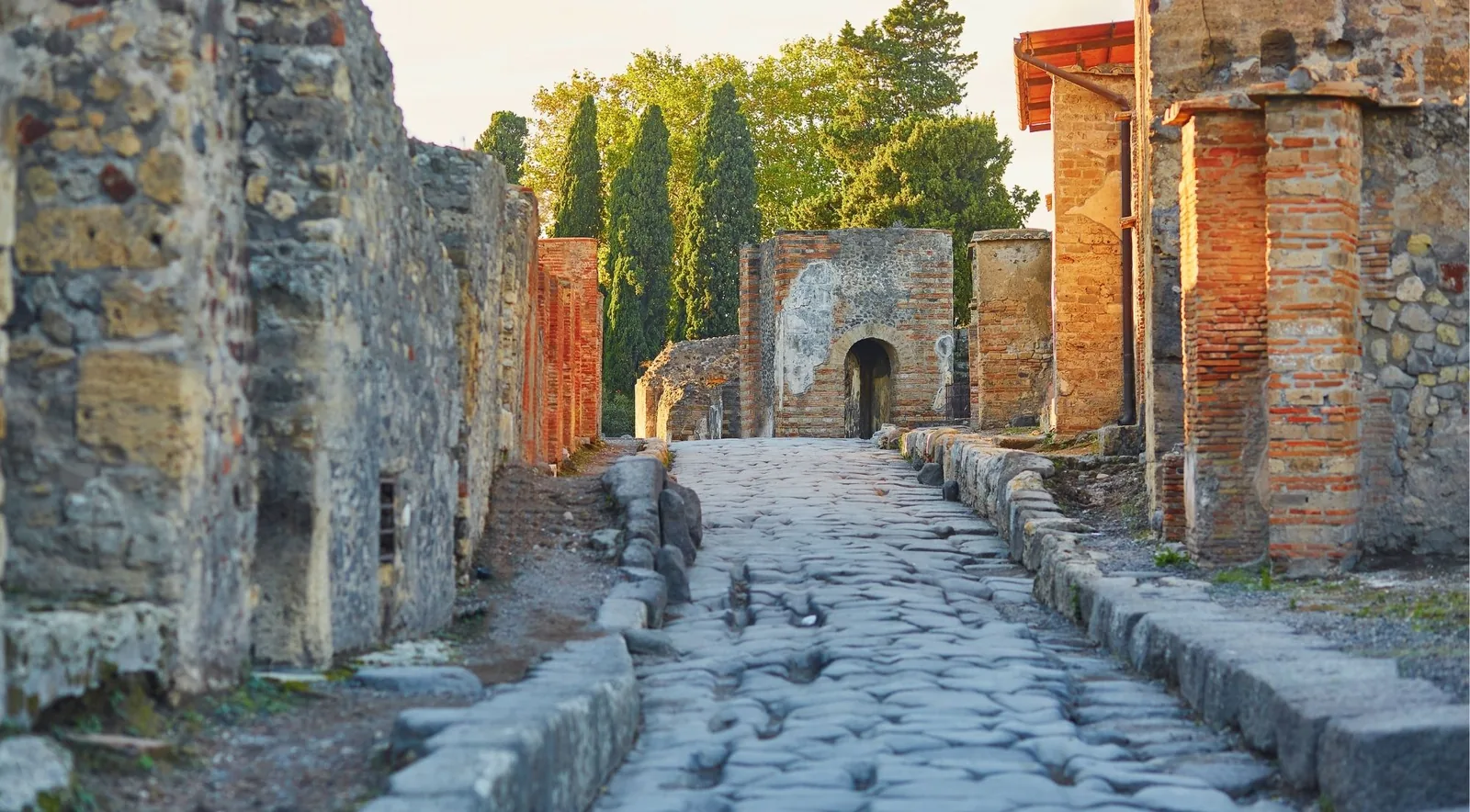
Pompeii is worth visiting with children. For most families, a two-hour guided tour or a two- to three-hour self-guided route works better than an exhausting full day. School-age children often love the Roman streets, bakeries, baths and theaters. Toddlers can come too, especially if you follow the park's Pompeii for All route from Piazza Anfiteatro, but the ancient paving and steps make a stroller visit harder going than an ordinary city walk.
The standard Pompeii Express ticket is €20 per paying adult, and under-18s of any nationality get into the park free, with ID and the free ticket issued through the park's ticketing. A paid family guide or package can still charge for children. Prices and rules here were checked on 4 November 2026; confirm them on the official tickets page before you book.
Planning the rest of the day? See our Pompeii tickets explained, the self-guided Pompeii route and our guide to visiting Pompeii.
Pompeii is not an amusement park or a conventional museum. It is an excavated Roman city where children walk along ancient roads and look into real houses, shops and public buildings. That is exciting at some ages and tiring at others.
| Age group | What usually works best | Time to plan inside | Main consideration |
|---|---|---|---|
| Babies and toddlers (0–3) | A short outing with a baby carrier, or a carefully chosen buggy-friendly section | 60–90 minutes, with flexibility | Uneven surfaces, diaper changes and naps |
| Preschoolers (4–5) | Short stops, simple stories, lots of movement | 1.5–2 hours | Attention span and tired feet |
| Primary-school children (6–11) | A playful guide, or a 2–3-hour route of your own with a Roman-life scavenger hunt | 2–3 hours | Too many similar houses |
| Tweens and teenagers (12–17) | A 2–3-hour history-focused or archaeologist-led tour | 2–4 hours, depending on interests | More depth, but still with breaks |
These are planning suggestions, not official age limits. Your child's stamina and interest matter more than a birthday. With children of different ages, plan around the youngest, or split the day into a short essential route and optional extras.
Unlike ancient objects behind glass, Pompeii lets children imagine a working city. They can hunt for stepping stones in the streets, spot a bakery's millstones, find courtyards and fountains, and picture a crowd arriving at the theater. The eruption of Vesuvius in AD 79 is a powerful story, but think beforehand about how to talk about the deaths with younger children.
The site is large, the walking surfaces are uneven, and some sections have few places to sit. A three-hour tour is easy for an energetic nine-year-old and overwhelming for a tired four-year-old, particularly after a train ride from Naples or Sorrento. It is much better to finish while everyone is still interested than to try to cover every sight.
Families rarely do Pompeii alone. Around the bay you can pair it with the smaller, easier excavations at Herculaneum, a Mount Vesuvius crater walk for children who want to see the volcano itself, the pizza and the National Archaeological Museum in Naples, or boat days from Sorrento along the Amalfi Coast. These tours and tickets around Pompeii suit a family trip.
For children of roughly five to twelve, a well-chosen family guide is often money well spent. The best guides talk about ordinary Roman life: food, baths, shopping, school, entertainment and what archaeologists have found. What you pay for is not someone talking for two hours but a guide who can turn the archaeology into stories children understand.
| Tour type | Best for | Advantages | What to check before paying |
|---|---|---|---|
| Private family-focused tour (about 2 hours) | Young children or mixed ages | Flexible pace, questions, games or child-oriented storytelling | Whether the guide specializes in families; admission and child charges |
| Small-group archaeologist-led tour (about 2 hours) | Older children and teenagers | Expert explanation and a manageable highlights route | Group size, pace, age suitability and whether entry is included |
| Private guide without entry tickets | Larger families who want flexibility | One group fee can compare well; custom route possible | The total after adult admissions, the meeting point and ticket booking |
| Short official thematic tour (about 1.5 hours) | Families who want an affordable guided introduction | Run by the park; shorter than many commercial tours | Language, availability, meeting entrance and the under-10 fee exemption |
| Self-guided visit | Budget families with an adult happy to plan | You control the stops, snacks and breaks | Route planning, weather, attention spans and navigation |
The park introduced 1.5-hour guided thematic visits in 2026, on Civic Pompeii or Daily Pompeii. At the time of review they cost €8 per person plus admission, with the guided-visit fee waived for children under 10. They are a separate product from commercial private family tours; check languages and sessions on the official independent-visitor page.
Pick a listing that describes what it does with children. An ordinary adult tour is not "kid-friendly" just because children are allowed on it.
A private archaeologist for your family alone, with commentary pitched at younger listeners and stories of Roman life told around the Forum. One price covers up to five people, so two adults and two or three children pay the same; children enter the park free and an adult Express ticket can be added at checkout. The guide sets the pace, which matters most when a five-year-old needs a break.
Check family tour datesFree cancellation up to 24 hours before · secure checkout via GetYourGuide
The alternative built only for children is the Pompeii: Skip-the-Line Tour for Kids and Families, a two-hour walk by a company that only guides families, using interactive learning tools and with the entry ticket included. It is rated 4.9/5 from more than 125 reviews, half the review base of the private family tour, and costs $137 per person, so it is the cheaper choice for one parent and one child but costs well over $500 for a family of four.
A private tour makes sense with three or more children, because one guide works around your family. Operators price differently, though: some charge one amount per group, others per person. Compare the total for your exact family size, not the headline adult price. The 2-hour private tour with an archaeologist guide, for example, is from about $260 (€225) per group of up to five and holds 4.9/5 from more than 850 reviews, while the small-group tour with an archaeologist is from $34 per person with the entry ticket.
Before booking, confirm:
For more on choosing a guide, see our Pompeii guided tours comparison and Pompeii tour costs.
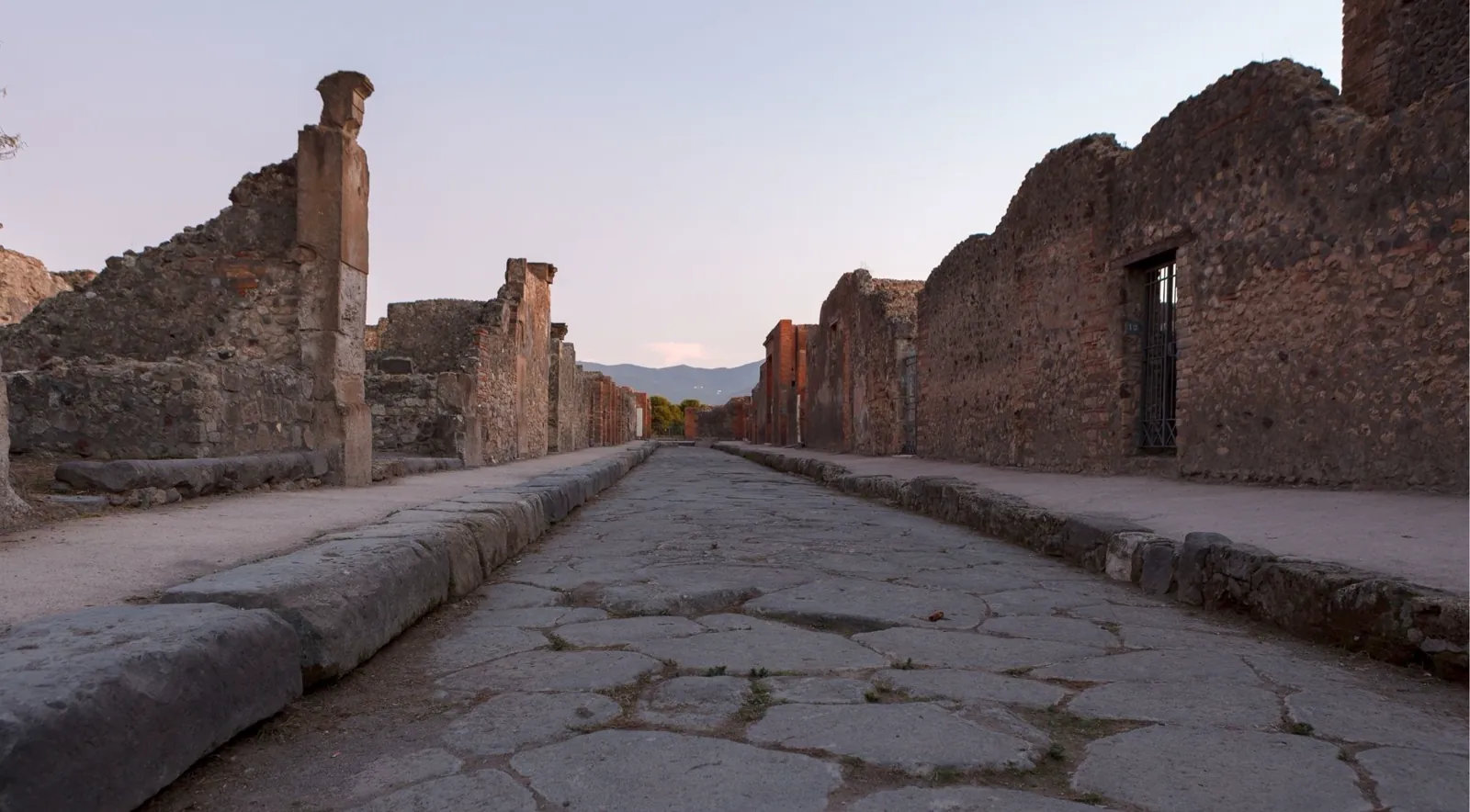
You don't need ten houses and six temples. Choose places that each tell a different story or look different.
The Forum was Pompeii's civic center, with important public buildings and temples around it. It is a strong first stop because children can see the scale of the town and, on a clear day, Mount Vesuvius beyond the ruins. Ask them: what might a busy town square have sounded like two thousand years ago?
These often hold children's attention better than another set of walls. Look at the raised stone crossings and the worn road surfaces, and ask them to imagine carts, people on foot and all the everyday movement of a Roman town.
A surviving bakery, a millstone or a thermopolium (a counter for ready-made food and drink) makes an ideal stop. Children can compare how Romans bought and prepared food with their own lunch. Which interiors are open can change, so check the park's current open-buildings list before promising a particular room.
Bathhouses show how different Roman daily life was, and children often enjoy hearing about rooms kept at different temperatures and about bathing as a social outing. If the interior is closed or busy, explain the idea from outside and move on.
One of Pompeii's easiest public spaces to understand: a place where a crowd gathered for performances. Older children can imagine the actors and the audience, and the open space is a change after enclosed houses and narrow streets.
Choose one house that is open and on your route. Look for an atrium, a garden, a painted room or a mosaic, then ask the children how their own home is different. One memorable house usually works better than rushing through several.
The Amphitheatre is a great choice for children fascinated by Roman spectacles, but it sits toward the eastern edge of the excavations. Include it if you start at Piazza Anfiteatro, follow an east-to-west route, or have the time and energy for the extra distance; don't tack it onto a short Porta Marina route by default.
Pompeii's casts make the eruption real in a way photographs and descriptions cannot. They also show people who died, which some younger children find upsetting. Decide beforehand whether they are right for your family, and check the current display before promising a particular cast.
| Approximate time | Stop | What to do with the children |
|---|---|---|
| 0:00–0:15 | Enter at Porta Marina and get your bearings | Open the official map; find the volcano and one Roman street |
| 0:15–0:40 | The Forum and the public spaces around it | Explain the ancient city center; play "spot the columns" |
| 0:40–1:05 | One open house or a nearby shop | Look for a courtyard, a cooking area or decoration; pick one good story |
| 1:05–1:20 | Toilet and rest stop if needed | Drink water and check everyone's energy |
| 1:20–1:50 | Via dell'Abbondanza and the Stabian Baths area | Find road crossings, shop fronts and a bathhouse, if open |
| 1:50–2:20 | The theater district | Imagine an ancient performance and take a family photo |
| 2:20–3:00 | An optional last house, the Antiquarium or the exit toward Piazza Esedra | Decide by the weather and the children's stamina |
This is no promise that every building will be open. Some houses keep their own hours, close for a while or limit numbers. Check the official Pompeii map and guide and the open-buildings list on the day.
Family tip: choose three must-sees before you go in, usually the Forum, an everyday-life stop and the theater. Anything else is a bonus.
For a fuller route, use our Pompeii self-guided walking tour and shorten it to suit your family.
Can you bring a stroller into Pompeii? Yes, but use the accessible route, not a standard walking itinerary. The park names parents with buggies, alongside visitors with mobility difficulties, as the people its Pompeii for All route is for.
The route starts at Piazza Anfiteatro and runs for more than 3.5 km toward the Sanctuary of Venus. A family with a toddler does not have to do all of it: choose a manageable stretch, or turn back the same way when your child needs a break. Even on this route, the park warns of:
A light, sturdy stroller is usually more practical than a bulky travel system, and a baby carrier is often the simplest answer for a very young child who will tolerate one. That is our advice; the park sets no equipment rule. Don't assume every house interior is stroller accessible.
Download the official Pompeii for All map before you arrive. The park lists an exit at Piazza Esedra using the Antiquarium lift, but check the current route with staff before relying on it for a timed pickup.
A private guide makes a stroller visit easier only if the operator agrees in advance to keep to the accessible sections. A listing that says "strollers allowed" does not mean its standard route avoids steps, so ask the operator to confirm the route before you book.
For a straightforward visit to the ancient city, most families need Pompeii Express, not a multi-site pass.
| Official ticket | Adult price (checked Nov 2026) | When it makes sense for families |
|---|---|---|
| Pompeii Express | €20 | A first visit focused on the main excavated city |
| Pompeii Plus | €25 | If you definitely want the suburban villas, including the Villa of the Mysteries, and have the time and energy |
| 3-day Greater Pompeii ticket | €30 | Only for families planning several archaeological sites over several days |
Children under 18 get in free. Italy's Ministry of Culture makes its state museums, monuments and archaeological sites free for visitors under 18, with no nationality condition, and Pompeii is a state archaeological park. Children under 12 must be with an adult. Bring a passport or other proof of age for each child and get their free tickets through the park's current ticketing procedure: tickets carry names, and staff can check ID. Free admission to the ruins is not free admission to an independently run guided tour.
Official online sales currently go through Pompeii's Vivaticket ticketing page. The park recommends booking ahead to save time at the entrance, which helps most when you have children with you.
Example budget: two adults and two children under 18 on park-only entry pay €40 in total, before any online fees, audio guides, guiding, transport or extras. A family tour from a commercial operator can come to a different total.
Other details to know:
Read the full Pompeii ticket guide for current options and restrictions.
The Naples–Sorrento Circumvesuviana line stops at Pompei Scavi–Villa dei Misteri, convenient for Porta Marina and Piazza Esedra and a practical choice for the school-age route above. Allow time for the walk to the gate, the bathrooms and the ticket and security checks, and don't plan a tightly timed arrival.
If you need the Piazza Anfiteatro entrance for the accessible route, don't assume Villa dei Misteri station is the nearest. The park also names Pompei Santuario on the Naples–Poggiomarino line and the mainline Pompei station as alternatives; choose by the entrance and service you will use. For more transport options, see Pompeii from Naples.
The same Circumvesuviana line links Sorrento with Pompei Scavi–Villa dei Misteri, so a self-guided family day trip works without a car. Ask your tour provider whether its meeting point is near Porta Marina, Piazza Esedra or elsewhere, and check the return trains before you go in.
A visit from Rome means much more travel, often high-speed and regional trains together or a long organized excursion. With younger children, the journey can take more energy than the ruins. Read our Pompeii tours from Rome before you commit to a full day. From the Amalfi Coast, compare transfers and day trips, since most towns there have no direct rail link.
If you would rather someone else handled the transport, check that the total travel time and the guided walk both suit your children. From Naples, the Pompeii tour from Naples with ticket, guide and transfer (4.7/5 from more than 2,950 reviews, from $53) lasts about three and a half hours, a manageable length for school-age children.
With children, good logistics matter more than an ambitious sightseeing list.
The park lists toilets near the Porta Marina, Piazza Esedra and Piazza Anfiteatro entrances and at several points inside, including the Antiquarium, the Quadriportico, Casina dell'Aquila, the Villa of the Mysteries and below the Temple of Venus. Use one when you see it instead of counting on the next being five minutes away.
The park has three baby-changing points: on Via dell'Abbondanza, on Via di Nola, and at the corner of Via Stabiana and Via della Fortuna. Its guidance is to collect the key at the site entrance and return it at the end of your visit; ask staff about the current procedure when you arrive.
There is an official self-service restaurant at Casina dell'Aquila inside the site. Pompeii is not a picnic park, though: the visitor rules forbid eating outside the designated areas. If your children need frequent food breaks, plan a proper meal before or after the visit, and check what is open on the day.
Bag-size rule: the park does not allow bags, cases or backpacks larger than 30 × 30 × 15 cm inside the excavations. Paid luggage storage is listed at Porta Marina and Piazza Anfiteatro. Check a large diaper bag or backpack against the limit before you set off. The official visitor services page has the details.
Winter suits families who prefer cool weather to summer heat. The trade-offs are shorter opening hours, earlier darkness and a greater chance of wet, slippery stone. The park's published timetable from 15 October to 15 March is:
Individual houses can close earlier, and the site normally closes on 25 December and 1 January unless an exceptional opening is announced. Check the park's official page for date-specific changes.
Milder days make walking pleasant, but rain is possible. Bring waterproof layers and keep the route flexible. Read our Pompeii in November guide.
For a family holiday around Christmas, check that your day is a normal opening date before booking transport or a private tour, and leave time to reach the station before dark. See Pompeii in December.
With younger children a morning visit is usually simplest: you explore in daylight and have lunch outside the park afterward. Read Pompeii in January.
February can be a comfortable month for families willing to dress in layers and plan around rain. If conditions are poor, shorten the route instead of hurrying over slippery stone. See Pompeii in February and our Pompeii in the rain guide.
Light rain need not cancel a visit, but slippery paving and little reliable shelter make it hard work with toddlers. Check weather warnings and park notices, ask whether your guide can adapt the route, and read the cancellation terms before you book. Some ancient rooms are covered, but they are no substitute for a full indoor museum visit.
Use these prompts to keep an independent visit lively. You can read them out instead of handing over a worksheet:
For older children, ask a harder question: what does Pompeii tell us about the lives of ordinary people, not just wealthy Romans? It works especially well near shops, street-front rooms and public spaces.
Pompeii is far bigger than most visitors expect. Choose a realistic route and stop while the children are still enjoying it.
A two-hour guide who uses games and family storytelling is not the same product as a specialist lecture that happens to allow children.
The official accessible route reduces barriers but does not remove uneven paving or steps.
Porta Marina suits Villa dei Misteri station; Piazza Anfiteatro is the start of the accessible route. Match the entrance to your route.
Free site admission for under-18s does not make the guide, the train or a private transfer free for children.
The park restricts eating to designated areas, so plan family meals around that rule.
If the plaster casts or adult-themed frescoes are likely to upset or confuse younger children, skip those stops.
It can be, especially if your child likes stories, walking and exploring new places. Aim for about 90 minutes to two hours, pick a small number of highlights and leave time for breaks. A specialist family guide can make the ruins far more engaging.
Yes. Plan a short visit, consider a baby carrier and check where the baby-changing facilities are. A buggy is allowed on the park's designated accessible route, but the ancient streets can still be uneven.
Yes. The park names parents with buggies among the visitors its Pompeii for All route is meant for, and the route starts at Piazza Anfiteatro. It is not flat or step-free everywhere, so download the official route map and ask staff about current conditions.
Yes. Under-18s of any nationality get free standard admission, because Italy's state museums and archaeological sites are free for visitors under 18; bring ID and get the free ticket through the park's ticketing. Commercial tours, transport and audio-guide rental can still charge for children.
For most first-time family visits, two to three hours is a good target. Toddlers may manage a good deal less; teenagers with a strong interest in history may want longer.
If your children respond well to storytelling, a good family-specific tour can make a real difference. Independent visits are cheaper and more flexible, especially if you are happy to prepare a simple route and talk about the site yourself.
Piazza Anfiteatro, because it is the start of the park's Pompeii for All route. For a standard family route from Pompei Scavi–Villa dei Misteri station, Porta Marina or Piazza Esedra is more convenient.
Yes, near the main entrances and at several points inside. Check the park map and use a toilet whenever it is convenient, without assuming another one is close by.
Only in designated areas, and the park has a self-service refreshment point at Casina dell'Aquila. Don't plan to picnic among the ruins. With young children, eating before you go in or after you leave is often easiest.
Adults need to supervise closely. The ancient paving is irregular, there are steps and drops, and the park's rules forbid running and climbing on the archaeological structures. Consider a carrier or a stroller if your toddler is unlikely to stay close.
That is a parent's call. The casts can be an important part of learning about the eruption, but they can also be upsetting. Decide by your child's age and sensitivity, and skip them if in doubt.
Yes. The park rents official audio guides, with a children's device at €5 against €9 for an adult, and it does not allow unauthorized audio-guide equipment on site. Check the languages and rental arrangements with the park.
The park launched two 1.5-hour thematic visits in March 2026. They are not designed as children's tours, but the short length suits many families. Check the current languages, availability and entry requirements; the tour fee is waived for children under 10.
Usually, yes. You start before the children get tired, avoid the stress of a late arrival and keep more daylight in winter. If you have booked a guide, make sure your transport leaves enough time to reach the exact meeting gate.
It can be excellent on a dry winter day, when the cooler air makes walking easier. It is mainly an outdoor site, though, so it is no dependable rainy-day attraction. Dress in layers, watch the weather and keep a shorter route ready.
For a first visit with school-age children, book a two-hour kid-focused guided tour, or follow a shortened route of your own covering the Forum, one house, a food stop and the theater. For teenagers, an archaeologist-led tour can be especially rewarding. For babies and toddlers, plan a shorter outing on the Piazza Anfiteatro accessible route and be ready to leave early.
Above all, make the day about discovering what it was like to live in a Roman city, not about ticking off as many ruins as possible.
Ready to plan your visit? Compare Pompeii guided tours, check Pompeii ticket options, or use our self-guided Pompeii itinerary to build your family's route.
Official information checked on 4 November 2026, and the under-18 rule on 11 November 2026. Prices, opening hours, house access and transport timetables can change.