- $34 From, per person
- 4.8 23,565 reviews · checked 3 Sep 2026
- 2 hrs Walking, ticket included
- 0 of 29 5-star reviews mention the audio
You're Paying for the Story, Not the Stones
This was not our first trip to Pompeii. We had been twice before, both times on our own — buy the €20 Pompei Express ticket, take the Circumvesuviana out from Naples, walk in at Porta Marina and wander until our feet gave out. That is still the advice we would give anyone on the timing: get the early train and be through the gate not long after nine, before the coach groups arrive.
Pompeii is worth the trip. It is a whole Roman city — sixty-six hectares inside the walls, around forty-four of them excavated — with the shopfronts still standing and the counters of the thermopolia set into the walls where people bought hot food on the way to work. There is election graffiti painted on the plaster by people who died in 79 CE. For €20, that is one of the better deals in Italian tourism.
We also thought we had seen most of it. We had not. Looking back, we walked past the House of the Faun without knowing what it was, spent a long stretch in the wrong half of the site, and ran out of energy before we got anywhere near the amphitheatre. The place is big, the labelling is thin, and there is no obvious route through it. Two visits in, we had a lot of photographs of walls and not much sense of what we had been looking at.
This time my sister came with us, and she was the one who pushed for a guided tour — specifically one with an archaeologist, on the grounds that we plainly had not got our money's worth on our own. So we booked the Pompeii entry ticket and guided tour with an archaeologist, run by Askos Tours: two hours, entry ticket included, currently from $34 a head.
Before we get into it, the genuinely useful part: we also went back through what travellers on recent departures reported, the two- and three-star write-ups every bit as much as the glowing ones. Four things come up again and again, and none of them is the thing the listing prepares you for.
The headsets are the weak link — they crackle, they cut out past about five metres, and on a bad day a good chunk of the group quietly gives up on them. Two hours buys you a fraction of the site — the amphitheatre and the plaster casts are not reliably in it. Starts run late, because tickets get sorted for several groups at once in the scrum outside the gate. And there is very little give in the booking if you turn up late or a rail strike lands on your morning.
None of those is a scandal, and none of them means the tour is bad. They are the predictable consequences of a cheap, high-volume, two-hour product at the gate of an enormous site — choices stated in booking notes that nobody reads to the end. But they are exactly the difference between a very good morning and a quietly disappointing one, and they are why the same tour collects fives and threes in the same week.
The trade-off this whole review comes down to: you are paying for the story, not the stones. The stones are there either way — €20 and a train fare gets you in, and we had already done exactly that twice. What you cannot get on your own is someone who can tell you what happened in them. That is what this tour is selling, and it is also the thing that varies most: the guides people rate badly are the ones who explain how a wall was built, and the ones people remember are the ones who explain who lived behind it.
Five Things Worth Knowing First
Three of these come straight out of the tour's weakest reviews. They are the ones that change the day.
- Assume the headsets will fail you, and stand close. This is the single most common complaint on the tour and it is not one bad batch — it has been the same story for years. The receivers lose the guide past roughly five metres, and in a group of twenty strung out along a street that happens constantly. Park yourself within a couple of paces of the guide and treat the earpiece as a backup, not the main channel.
- Book the 9:00 or 9:30 slot, and in July and August treat it as non-negotiable. There is no shade worth the name in the Forum and the stone throws heat back at you all afternoon. An early start is the difference between two pleasant hours and two hours of slog.
- Give yourself the whole day, not just the two hours. Your ticket stays valid after the guide hands back the headsets, and the tour will not reach the amphitheatre, the Large Palaestra or, often, the plaster casts. From 16 March to 14 October the site runs 09:00–19:00 with last admission at 17:30; in winter it is 09:00–17:00 with last admission at 15:30. A 9am tour therefore leaves you most of a day in hand. The people who come away happiest treat the tour as an orientation and then spend another two or three hours walking the site themselves.
- Check the strike register before you book, and again the day before. Turn up ten minutes late and the group is gone, and rail disruption is not treated as grounds for a refund or a reschedule. This is not hypothetical on this route: the Circumvesuviana ran 24-hour strikes on 6 March and again on 9–10 May 2026, and the national operators struck on 23–24 July. Italy publishes every planned action at scioperi.mit.gov.it. When a strike is on, only the protected bands run — roughly 05:30–08:30 in the morning on the Circumvesuviana — which is another argument for the early departure. Cancellation is free up to 24 hours ahead, so commit early and move the booking if the notices go up.
- Check whether your date is a free-entry Sunday before you pay for a ticket you don't need. On the first Sunday of every month Pompeii is free to enter under the culture ministry's Domenica al Museo scheme, and the €20 entry ticket is bundled into this price — a bit over a third of it at current rates. On those days you cannot pre-book at all and everyone walks straight through the turnstiles, so it is also the busiest day of the month. Either pick a different date, or go in knowing you are paying for the guide alone.
Check Dates Before You Read On
Two practical reasons to look now rather than later. The meeting point and start time both change depending on which language option you book — English, Italian, French, German, Spanish and Portuguese all run, and they do not all gather in the same place. And cancellation is free up to 24 hours ahead, which on a route this exposed to rail strikes is the whole argument for pinning a date early and keeping the option to move it.
What the Day Actually Looks Like
The meeting point is outside the Porta Marina entrance, a few minutes' walk uphill from Pompei Scavi–Villa dei Misteri station. You are told to arrive fifteen minutes early. Do that — but go in expecting the fifteen minutes to become thirty.
Sort your bag before you arrive. Anything larger than 30 x 30 x 15 cm will not go through security, which catches out a lot of people carrying a normal day pack. The park lists luggage deposit as a paid service at the Porta Marina and Piazza Anfiteatro entrances and does not publish a price — travellers report a few euros a bag. The station lockers at Pompei Scavi are the other option. Either way, do not turn up at the gate with a suitcase and expect to talk your way in.
This is the part of the morning the listing does not describe. Askos runs several groups off the same patch of pavement at once, in several languages, and the tickets for all of them are collected at the gate rather than issued in advance. On a good morning you are sorted, badged, handed a receiver and moving in ten minutes. On a bad one, people stand around for half an hour not knowing which guide is theirs, and the delay comes out of the two hours you paid for rather than being added to the end. Late starts of twenty to thirty minutes are common enough that you should not book anything tight for the back end of the morning.
Once you are walking, the shape is consistent: in through Porta Marina, up to the Forum and the Basilica, then a loop through the residential and commercial streets — a bath complex, a bakery, a thermopolium counter, one or two of the big houses — and out. Two hours, on foot, on Roman basalt paving that is uneven in a way modern feet are not prepared for. Group size is advertised as up to twenty. Twenty is what you usually get, and on the busier summer slots people have counted more.
Then the guide hands the headsets back, points you at what you have not seen, and leaves. Your ticket is still live. What you do with the rest of the day is the single biggest variable in whether this tour was worth it.
Building the Rest of the Bay of Naples Around It
Almost nobody comes to Pompeii and does only Pompeii. The obvious pairings are a Mount Vesuvius crater walk in the afternoon, Herculaneum for the smaller, better-preserved sibling site, the Amalfi Coast road down through Positano, a boat across to Capri, or an hour in Naples at the Archaeological Museum, where most of Pompeii's best mosaics and frescoes actually live. Check live prices and times below.
What You Actually See, and What It Is Worth
Stop #1 — Porta Marina and the first twenty minutes
The gate is the right way in — you climb the same ramp the Romans did up from the old harbour, and the city opens out at the top of it. It also sets up the first real difference between guides.
Some use the climb to set the scene properly: what the harbour was, where the shoreline sat before the eruption pushed it back, what you are about to walk into. Others park the group just inside the gate and deliver twenty-five minutes of general Roman history before anyone has seen anything. On a two-hour clock, twenty-five stationary minutes at the entrance is a lot of your tour, and it happens often enough to plan around — along with a tendency to spend the time on how things were built rather than on what happened here.
How to set your expectations: if your guide is still doing preamble fifteen minutes in, that is a signal about the rest of your two hours. It is not a reason to bail, but it is a reason to plan on staying afterwards.
Stop #2 — The Forum and the Basilica
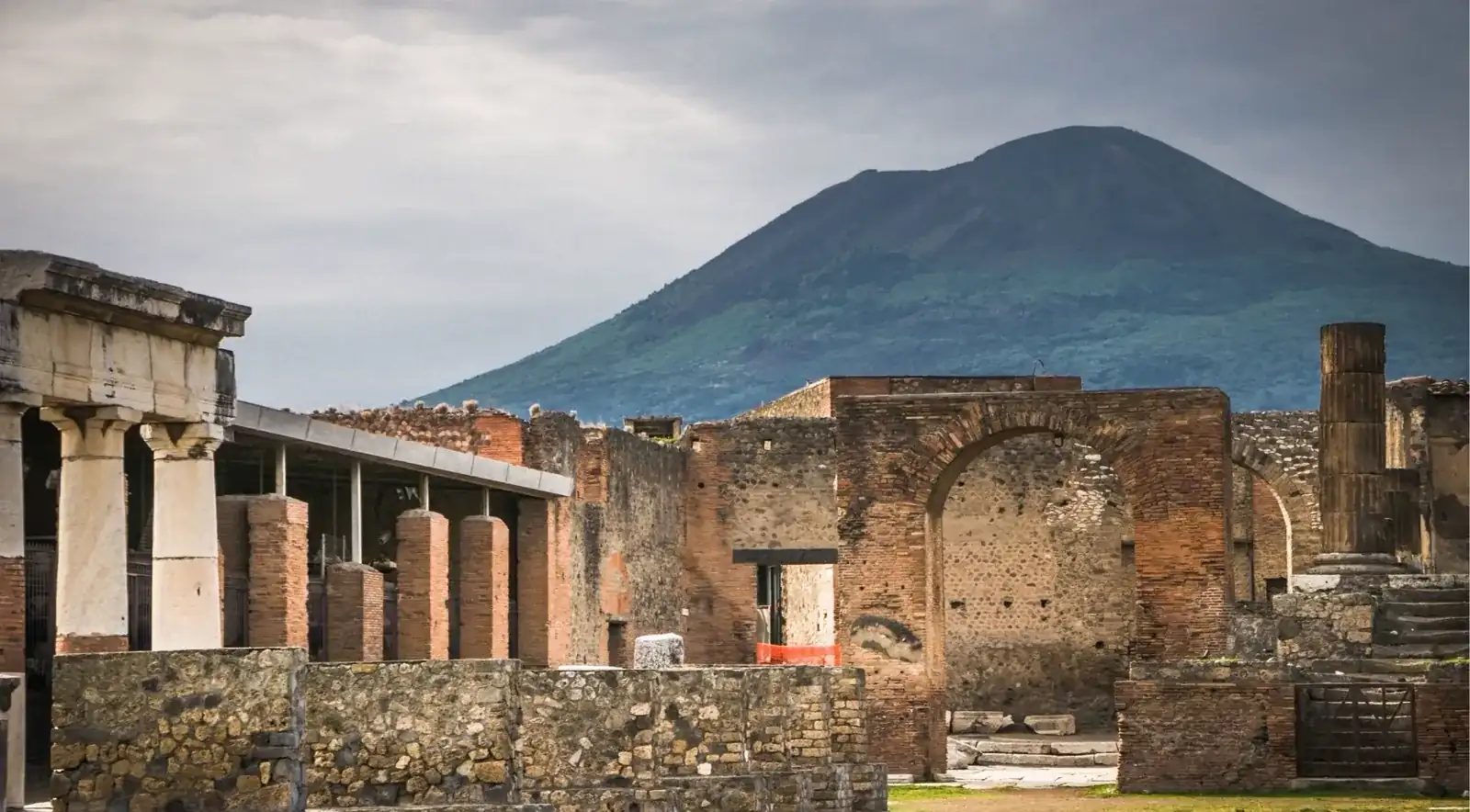
This is the part that reliably works, and it is where the tour earns its money. The Forum is the civic heart of the city, the Temple of Jupiter closes the north end of it, and Vesuvius sits directly behind — one of the few views anywhere that explains an entire historical event without anyone having to say a word.
A good guide does something specific here that you genuinely cannot do alone: reads the square as a working space. Where the market was, where the money-changers sat, where the public notices went up, which of the columns are original and which were re-erected by archaeologists. The Basilica next door is the law court, and it is the single best place on site to understand what a Roman public building actually felt like.
How to set your expectations: this is the strongest stop on the tour and it is crowded. It is also where a bad receiver hurts most, because the guide will be pointing at things thirty metres away.
Stop #3 — The baths, the bakery and the thermopolium
The middle stretch is the texture of the city and it is where the archaeologist framing should pay off. The bath complex still has its vaulted ceilings and the shelves where people left their clothes. The bakeries have their millstones. The thermopolium counters — the fast-food bars, with the round holes cut for the storage jars — are the single detail that most reliably makes people realise this was a city where people bought lunch.
This is also the part of the route that varies most between guides. The itinerary lists the Lupanar, the House of the Faun and the Termopolium; some tours take in all of them, some substitute, some describe a building and tell you to come back to it afterwards. Turn up expecting the brothel or the House of the Faun and there is a fair chance you get pointed at it rather than taken into it.
How to set your expectations: treat the listed stops as a menu rather than a timetable. If there is one specific thing you have come for, say so to your guide in the first ten minutes — the ones who are good are very good about routing to it.
Stop #4 — The plaster casts, if you get there
The casts of the victims are what most people picture when they picture Pompeii, and they are the most common thing to not see on this tour.
Fair version first: there are casts in the Macellum on the Forum's east side, and plenty of groups do stop at them. But the larger, more affecting displays are elsewhere on the site, and a two-hour route that starts late does not reliably reach them. Coming away without having seen a cast at all is a specific and common disappointment, and it is usually what separates the people who call this tour excellent from the people who call it merely fine.
How to set your expectations: ask your guide at the start where the casts are on today's route. If the answer is vague, go and find them yourself afterwards — the Antiquarium near Porta Marina and the Macellum are both close to where you finish, and the amphitheatre end of the site is a genuinely good hour on your own.
The Things That Can Go Wrong
Structural first — the things that are properties of the product rather than bad luck.
- The audio equipment is the weakest part of this tour, by a distance. Static, dead receivers, a range of about five metres, and earpieces that are often grubby as well as unreliable. Whole groups end up abandoning them and crowding the guide. It is worth understanding that this is not an occasional fault: it is the single most common criticism of the tour and it has been consistent for years.
- The two-hour format cannot cover the site, and the marketing does not make that obvious. Forty-four excavated hectares, two hours, one guide. You will see the civic core and a slice of the streets. You will probably not see the amphitheatre, the Large Palaestra or the Villa of the Mysteries, which is not even on the Express ticket.
- Starts run late and the lost time is not added back. Multi-group ticket collection at the gate is the cause. Twenty to thirty minutes is common.
- The booking is unforgiving. Late arrivals are not waited for, and rail disruption on the way — which on this line is a genuine and recurring risk — is treated as your problem. Ask for a reschedule after a strike has stranded you and the answer is generally no.
- Guides do not carry flags or paddles. In a site this crowded, with twenty people and unreliable receivers, groups do get separated, and the recovery process is slow.
- It is not suitable for wheelchair users or anyone with significant mobility limits, and the operator states this plainly. The paving is genuinely rough.
And the luck-of-the-draw ones:
- Guide quality is the whole experience, and it varies more than it should. Go twice in one week and you can get two entirely different tours off the same booking — one thorough and warm and running the full two hours, one hurried and finished in eighty minutes. When it lands well it lands very well: the same names keep coming up — Alexandra, Mena, Amadeo, Yolanda, Antonella, Giancarlo, Antonio, Paolo — and it is always the same things that get remembered. Politics, trade, the texture of ordinary life, and a guide who will actually take questions.
- Accents and audibility. Guides are Italian and working in English, which is fine in the open air and much less fine through a crackling receiver at five metres. The two problems compound each other, and together they do more damage to this tour than either would alone.
- "Archaeologist" is not a guarantee of a different tour. Some guides genuinely are archaeologists and it shows immediately. Others deliver a competent general tour that would not be out of place anywhere, and people who booked specifically for the expertise have noticed.
If the group-size and headset problems are what worry you — and on this tour they are the right things to worry about — the same operator sells a small-group archaeologist tour of Pompeii that sidesteps both. It runs headsets only for groups of sixteen or more, so a genuinely small group just listens to the guide directly, and it offers a three-hour option as well as the two — including a three-hour version that takes in the Villa of the Mysteries, which the Pompei Express ticket on this page does not cover at all. It is rated 4.8 from just over 14,000 reviews — statistically indistinguishable from this one — and at the time of writing it is priced from $38 per person against $34 here. We checked both prices on the same day, in the same currency. If you were going to book the tour on this page, look at that one first.
So — Would We Book It Again?
Yes, with a condition attached, and the condition is the review.
At $34 with the €20 (about $23) entry ticket bundled in, the guiding itself is costing you something in the region of $11 for two hours at one of the great archaeological sites on earth. When the guide is good — and on the evidence of how people rate the guiding specifically, they usually are — that is straightforwardly good value, and Pompeii without any explanation at all is a much poorer day than most first-timers expect. The guiding is consistently the highest-rated part of this tour. Value for money is consistently the lowest, and once you see what the two hours actually covers, it is obvious why.
Book this tour if you want a solid orientation to the civic core of Pompeii from someone who can read it for you, you are planning to stay on afterwards and walk the rest of the site yourself, and you can get to the meeting point with time in hand. That is a genuinely good morning and a lot of people have had exactly it.
Book something else if any of three things are true:
- Group size and audibility are your main worry. Take the same operator's small-group version — fewer people, no headsets below sixteen, a three-hour option, at about $38 per person.
- You are coming from Naples and the journey is the risk you want to remove. A Pompeii tour with the transfer included puts the strike risk on the operator instead of you — rated 4.75 from about 2,400 reviews at around $52 per person, and it includes getting you there and back.
- You are a family or small party who want the guide to yourselves. There is a private family tour with an archaeologist, rated 4.9 from 256 reviews, from $347 for the whole party of up to five. Do the arithmetic honestly: its listing sells the entry ticket as a checkout extra, so five people pay about $69 each for the guiding plus about $23 each for admission — roughly $92 a head, against $34 a head on the shared walk. What you buy is a guide who is yours alone, no receivers and your own pace; it never undercuts the shared tour on price. For a family with restless children that is often the right call. For two adults it is not.
One thing we are not doing. There is another private archaeologist tour on this site at around $521 whose own price label reads "per group up to 1", which is either a mistake or a per-person price dressed as a group rate. We are not sending anyone to a five-hundred-dollar booking whose pricing basis we cannot pin down.
What we tell friends who ask is simpler than any of this. Pompeii deserves a guide, and this is a reasonable and very popular way to get one — but book the early slot, stand near the front, and clear your afternoon. The tour is the introduction. The site is the day.
Pompeii Archaeologist Tour: Common Questions
Answer-first — the questions people actually ask before booking this one.
Is the Pompeii archaeologist tour worth it?
For most first-time visitors, yes — with a condition. The €20 (about $23) entry ticket is bundled into the price, so the guiding itself works out at roughly $11 for two hours, and Pompeii with no explanation at all is a much poorer day than most people expect. The condition is that two hours cannot cover the site. Treat the tour as an orientation, then stay on with the same ticket and walk the rest yourself. People who do that rate the experience far higher than people who leave when the guide does.
How much of Pompeii does the 2-hour tour actually cover?
The civic core and a slice of the streets: in through Porta Marina, the Forum and Basilica, a bath complex, a bakery and thermopolium counters, and one or two of the major houses. It does not reliably reach the amphitheatre, the Large Palaestra or the plaster casts, and the Villa of the Mysteries is not on the Pompei Express ticket at all. Around 44 of Pompeii's 66 walled hectares have been excavated, so two hours is always going to be a sample.
What is the biggest problem with this Pompeii tour?
The audio equipment. The receivers lose the guide past roughly five metres, they crackle, and the earpieces are often grubby. In a group of twenty strung along a street that happens constantly, and whole groups end up abandoning the headsets and crowding the guide instead. It is the single most common criticism of this tour and it has been consistent for years. Stand within a couple of paces of the guide and treat the earpiece as a backup.
What happens if a train strike makes me late for the tour?
You lose the booking. Late arrivals are not waited for, and rail disruption is not treated as grounds for a refund or a reschedule. This is a real risk on this route — the Circumvesuviana ran 24-hour strikes on 6 March and 9–10 May 2026, and the national operators struck on 23–24 July. Check scioperi.mit.gov.it before booking and again the day before. During a strike only the protected bands run, roughly 05:30–08:30 on the Circumvesuviana. Cancellation is free up to 24 hours ahead, so move the booking rather than lose it.
Is there a cheaper version of this Pompeii archaeologist tour?
Yes, from the same operator. Askos Tours also sells a small-group archaeologist tour of Pompeii rated 4.8 from just over 14,000 reviews, priced from $38 per person against $34 for this one — both checked on 3 September 2026 in USD. It runs headsets only for groups of sixteen or more, so a genuinely small group listens to the guide directly, and it offers a three-hour option as well as the two. If group size and audibility are your concerns, book that one instead.
How big is the group on the Pompeii archaeologist tour?
Advertised as up to 20 people, and 20 is usually what you get. On busier summer slots people have counted more. Headsets are provided for groups of 10 or more, which in practice means almost always. If you want a genuinely small group, the same operator's small-group tour or a private tour capped at five are the alternatives.
Should I book Pompeii on a free-entry Sunday?
Probably not, unless you want the guide alone. On the first Sunday of every month Pompeii is free under the culture ministry's Domenica al Museo scheme, and the €20 ticket is a bit over a third of this tour's price — so you are paying full price for an entry ticket you would not have needed. Those days also cannot be pre-booked and everyone walks straight through the turnstiles, making it the busiest day of the month.
Is the guide really an archaeologist?
Usually, and when it shows it shows immediately — the strongest guides read the Forum as a working space and talk about politics, trade and daily life rather than reciting dates. But it is not a guarantee of a different tour: some guides deliver a competent general tour that would not be out of place anywhere, and people who booked specifically for the expertise have noticed. Guide quality is the single biggest variable in whether this tour lands.
How We Put This Together
Written from two earlier independent visits to Pompeii on a standard entry ticket and one booking of this particular tour — plus a read through what travellers on recent departures reported, the low ratings as much as the high ones, because that is where the useful warnings live. The rating (4.81 from 23,565 reviews) and the price (from $34 per person) were checked on 3 September 2026; its category subscores (guiding 4.89, value for money 4.60) were last checked on 20 August 2026. All of them move with the season.
Ticket prices, opening hours and the free-entry Sunday policy are the Italian culture ministry's and the archaeological park's, not the operator's, and change independently — confirm on pompeiisites.org before you travel.
We earn a commission if you book through the links on this page, at no extra cost to you. It does not change what goes in the review — the small-group tour we point you to above is cheaper than the one we are reviewing, and the private option is the one we tell most couples to skip.
Still deciding how to structure the visit? Our guides to Pompeii guided tours, Pompeii tickets explained and what nobody tells you before visiting Pompeii cover the ticket system, the entrances and the station traps in full.