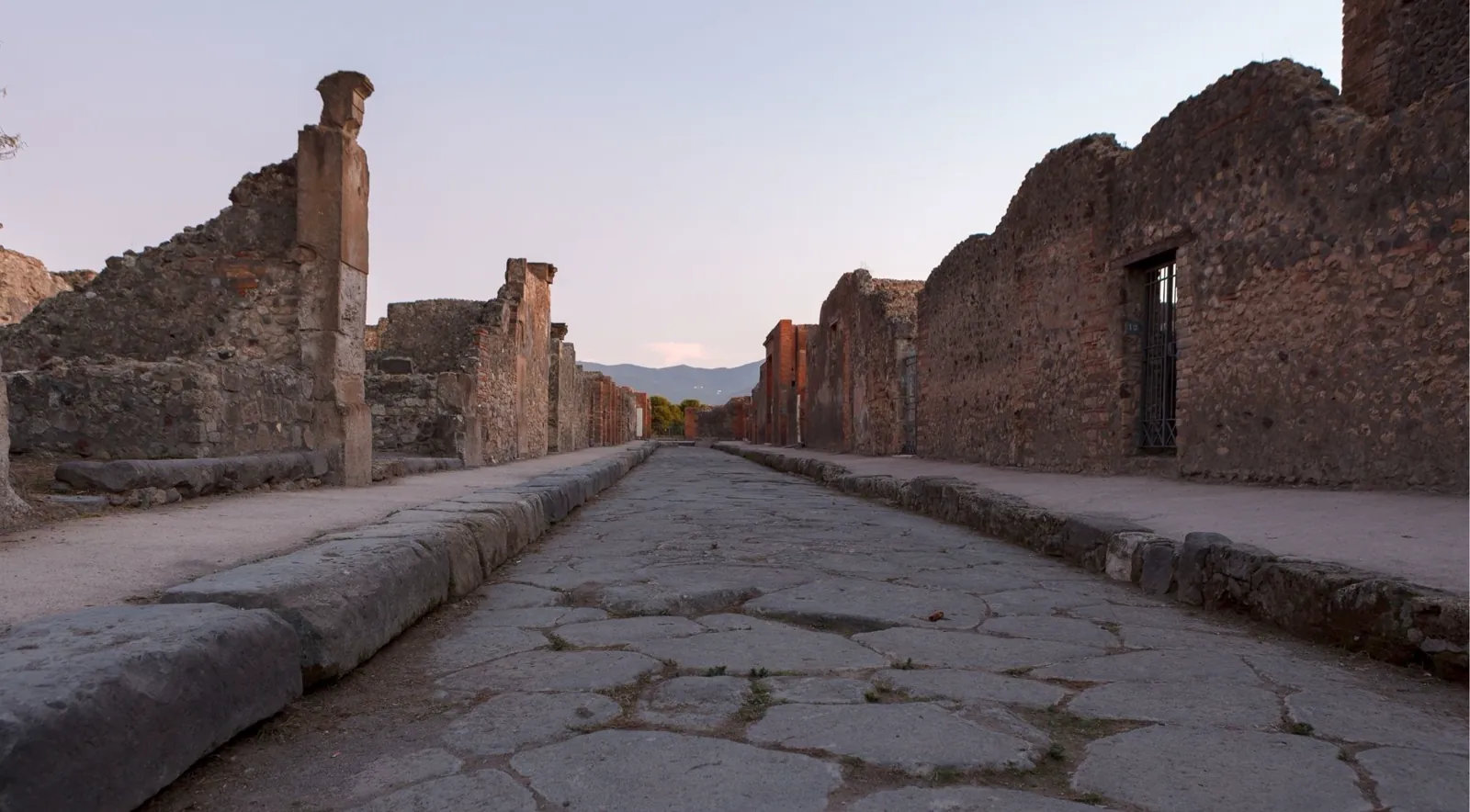
- 2 hrsWestern highlights
- 3 hrsOur favourite short visit
- 5 hrsWest to east, or the Villa
- 3:30 PMLast park entry, 15 Oct–15 Mar
- 1 entryPer standard ticket
Three Hours Is the Best Short Visit
Pompeii rewards wandering, but it is also enormous. It isn't a museum with rooms in a row: it is an ancient Roman city whose streets, shops, fountains, courtyards and public buildings are still connected. The best itinerary is not the one with the longest checklist. It is the one that lets you see how people lived before Vesuvius erupted in AD 79. A two-hour walk with an archaeologist, such as the Pompeii entry ticket and guided tour with an archaeologist, gives any of the routes below a good start.
For the full winter timetable and holiday closures, see Pompeii winter opening hours.
Choose Your Winter Route
| Time | Route | Start | Best ticket |
|---|---|---|---|
| 2 hours | Essential western highlights | Porta Marina | Express €20 |
| 3 hours | Civic, domestic and commercial life | Piazza Esedra | Express €20 |
| 5 hours | West-to-east city crossing | Porta Marina; finish at Piazza Anfiteatro | Express €20 |
| 5 hours, alternative | Western city and the Villa of the Mysteries | Porta Marina | Plus €25 |
The park publishes its own two-, three- and five-hour routes. The itineraries below pick and adapt their highlights for the shorter winter day. Building access, excavation work, the weather and your walking pace may all mean changes on the day.
Other Experiences You Might Enjoy
A winter day at Pompeii leaves time for more of the bay. You could see the frescoes and household finds in the National Archaeological Museum of Naples (its mosaic galleries are closed for now and the Alexander Mosaic is being restored), walk the preserved houses of Herculaneum, climb to the crater of Mount Vesuvius on a clear day, visit the villas at Oplontis, or spend a day in Sorrento and on the Amalfi Coast. If you want Herculaneum on the same day, our Pompeii and Herculaneum in one day plan shows how to fit both in before the 3:30 p.m. last entry. These are tours and tickets around Pompeii.
Winter Hours Shape the Itinerary
Between 15 October and 15 March, Pompeii opens at 9:00 AM, takes its last visitors at 3:30 PM and closes at 5:00 PM. Some of the famous buildings stop admitting people earlier than the park: the Antiquarium's last entry is 4:00 PM, and the park lists the same 4:00 PM last entry for several of the main houses, including the House of the Vettii.
Arriving at 3:30 PM does not leave you time for a three-hour itinerary. For a five-hour visit, start at opening. For two or three hours, arriving around 9:00 to 10:00 AM still gives you the most flexibility. The park is closed on 25 December and 1 January unless it announces otherwise.
Which Entrance Should You Choose?
Porta Marina: the best start for many train travellers from Naples and Sorrento, because Pompei Scavi–Villa dei Misteri station on the EAV Circumvesuviana is only a short walk away. It is the logical way in for the Forum and the western city.
Piazza Esedra: useful if you want to begin near the Antiquarium and the theatre district. It is also on the western side.
Piazza Anfiteatro: serves the Amphitheatre in the east and the start of the accessible Pompeii for All route. If you finish a one-way crossing here, remember that your return train may not be at the entrance you came in by.
The park's official archaeological map shows all three. Coming by train from the coast? Our guide to Pompeii from Sorrento and the Amalfi Coast in winter covers the journey, and Pompeii from Naples in winter covers the city side.
Two-Hour Itinerary: The Essential Western Loop
Best for: tight schedules, young families and first-time visitors who want a compact introduction, not a rushed attempt at the whole city.
9:00–9:15 AM: Porta Marina to the Forum
Enter near the western city and walk towards the Forum. Look at the ancient paving and at how the public buildings cluster round the civic centre. From the first few streets you can tell this was a working city.
9:15–9:40 AM: The Forum and the Sanctuary of Apollo
Pompeii's Forum was its religious, commercial and administrative centre. Take in the civic buildings around it and the Temple of Jupiter; on a clear day Vesuvius rises behind it. Nearby, the Sanctuary of Apollo introduces the city's religious history, which began before the Roman colonial period.
9:40–10:00 AM: The Forum Baths
Public bathing was a social activity as well as a practical one. Look round the rooms you can enter and work out how the heated and cooler sections were used. Some interiors may be temporarily closed, so check before you walk over.
10:00–10:25 AM: The House of the Faun
One of Pompeii's most impressive elite homes, whose courtyards and reception rooms show off the family's wealth. The famous Alexander Mosaic was found here, but the original is kept in the National Archaeological Museum of Naples.
10:25–10:45 AM: One more house
Choose a house that is open, such as the House of the Vettii if time and the current opening allow. Its richly painted rooms are a contrast to the spacious architecture of the House of the Faun. Don't insist on two houses if there is a queue or access is limited.
10:45–11:00 AM: Back towards the exit
Follow the signed route to a western exit, and leave yourself time for the walk; the gate is rarely right beside you. This route is a satisfying introduction, not a complete visit to Pompeii.
What to skip in two hours: the Amphitheatre, the far eastern houses and the Villa of the Mysteries. They are rewarding, but the extra walking eats into time better spent getting to know the western city.
Three-Hour Itinerary: Our Favourite Short Visit
Best for: first-time visitors who want to understand Roman daily life through its homes, public spaces, shopping streets and entertainment.
Start and finish: Piazza Esedra, subject to the current routes and exit arrangements.
9:00–9:35 AM: The theatre district
Enter from Piazza Esedra and visit the Large Theatre and the smaller Odeion. These spaces are a reminder that Pompeii was a lively city of performances, gatherings and entertainment. The buildings nearby show how public architecture was reused over time.
9:35–10:00 AM: The House of Menander
A substantial home with decorated rooms and courtyards. Its modern name comes from a painting associated with the Greek playwright Menander. Notice how the rooms that faced visitors related to the family's private spaces. If conservation work has closed it, go to another open house instead.
10:00–10:25 AM: Via dell'Abbondanza and the Stabian Baths
Follow part of one of Pompeii's main shopping streets. Shopfronts, fountains and stepping stones make everyday Roman life easy to picture. Then explore the public baths and what they meant as places to meet.
10:25–10:45 AM: The Lupanar and the streets around it
The Lupanar tells you a lot about the city, but it is small and can draw a queue. It contains explicit Roman images, so families may prefer to skip it. Don't let one building's queue stop you seeing more of the city.
10:45–11:20 AM: The House of the Faun and the House of the Vettii
Two highlights that complement each other: the architecture of a wealthy family's house, and some of Pompeii's most vivid wall paintings. If both are open, make time for each; if not, choose your favourite and move on.
11:20–11:50 AM: The Forum and its temples
Finish at the civic centre. After the houses, shops and theatres, the role of the Forum makes more sense. Pause for the view of Vesuvius and picture the city as it was before the eruption.
11:50 AM–noon: Back to Piazza Esedra
With an extra half-hour, the Antiquarium is a useful addition for its finds and the history of the excavations. Don't assume its exhibitions keep exactly the same hours as the open-air park.
Why this is our favourite: three hours give you a clear picture of civic, home and commercial life without wearing you out. If you can, allow a fourth hour to go back to the places that interested you most.
Five-Hour Itinerary: Cross Pompeii from West to East
Best for: confident walkers and history lovers who want a sense of the scale of the whole city.
Start: Porta Marina. Finish: Piazza Anfiteatro. This is a one-way route, so plan your journey home from the eastern side.
9:00–9:40 AM: The Antiquarium and the Forum
Start at the western entrance. If you want archaeological background, visit the Antiquarium once it opens (it is closed for refurbishment from 23 November to 7 December 2026), then continue to the Forum for the Temple of Jupiter, the Sanctuary of Apollo and the buildings around them.
9:40–10:20 AM: The civic buildings
Spend longer on the Forum's architecture. Think about how markets, government, worship and displays of status shaped the centre of a Roman town. There is more here than the famous photograph of Vesuvius.
10:20–11:00 AM: Wealthy Pompeii at home
Visit the House of the Faun and the House of the Vettii if they are open, and compare their courtyards, reception rooms, wall paintings and size. This is often the part of the day where a guide's explanation adds the most.
11:00–11:35 AM: Baths, shops and the Lupanar
Move on to the Stabian Baths and the shopping streets. Look for the food counters, the fountains and the layout of the workshops. Visit the Lupanar if it suits your interests and the queue is short.
11:35 AM–12:15 PM: The theatre district and Via dell'Abbondanza
Visit the theatres, then head east along Via dell'Abbondanza and watch how the street links one district to the next. Look at the outside of the Fullery of Stephanus when it is open, an example of how people cleaned and processed cloth.
12:15–12:30 PM: Rest
Use the official rest and refreshment areas, drink some water and check that the eastern route is open. Five hours on uneven stone can be more tiring than the same time on a level city street.
12:30–1:15 PM: Eastern houses and gardens
Pick open highlights such as the House of Venus in the Shell, the House of Octavius Quartio or the Praedia of Julia Felix. Don't force all three into a short window. Their garden paintings and layouts add another side to home life at Pompeii.
1:15–2:00 PM: The Amphitheatre and the Large Palaestra
The Amphitheatre is among the earliest surviving buildings of its kind. Next to it, the Large Palaestra and its displays give a different view of the city's public life and of the eruption. Leave through Piazza Anfiteatro.
Practical catch: the eastern exit is not next to the Pompei Scavi station on the western side. If you are going back to Sorrento or Naples, decide beforehand whether a taxi, a train from a station in the modern town or a walk back west suits you best.
Five-Hour Alternative: The Villa of the Mysteries
If ancient frescoes matter more to you than the Amphitheatre, stay in the western city and follow the Pompeii Plus route out to the Villa of the Mysteries. This suburban villa holds an extraordinary cycle of frescoes, often linked to the rituals of Dionysus.
Ticket: Pompeii Plus at €25, not the standard €20 Express.
Suggested order: the Forum, the House of the Faun, the House of the Vettii, the suburban villas route, the Villa of the Mysteries, then more of the western city and the exit.
Allow time for the extra walk, and reach the suburban route through Porta Ercolano well before its 3:30 PM winter cutoff. The villa building may close later, but the cutoff on the route still applies.
If you would like a guide for this half of the day, the 3-hour Villa of the Mysteries tour with an archaeologist (4.8/5 from 1,441 reviews, from $57) includes the Pompeii Plus ticket, and you can carry on alone afterwards.
Which Sights Are Really Unmissable?
If your time is limited, put these first: the Forum for the scale of civic life, the House of the Vettii for painted interiors, the House of the Faun for a grand home, the Stabian Baths for Roman engineering and the theatre district for public life. Add the Amphitheatre if you are exploring the eastern side, and the Villa of the Mysteries if frescoes are what you came for and you have the right ticket.
The small details deserve attention too: wheel ruts in the roads, raised stepping stones, worn doorsteps, drinking fountains, shopfronts and ancient inscriptions. These everyday traces often stay with you longer than photographs of every famous building.
Guided Tour or Independent Route?
A two-hour tour with an archaeologist is an excellent introduction when time is short, because it gives meaning to buildings that might otherwise look like anonymous walls. The Pompeii entry ticket and guided tour with an archaeologist (4.8/5 from more than 25,000 reviews, from $34) is the most-reviewed tour of its kind and includes your Express ticket. For a three-hour visit, we like about two hours with a guide followed by an hour on your own. For five hours, take a longer private guide, or join a morning introduction and explore alone afterwards; our Pompeii self-guided walking tour describes each stop for the part you walk alone.
The private options are priced per group, so they make more sense for a family or a few friends:
- The Pompeii private tour with an archaeologist: 4.9/5 from 208 reviews, from $521 per group, three hours with admission included.
- The Pompeii 3-hour private tour: 4.8/5 from 178 reviews, from $422 per group; the Express ticket is an option at checkout.
- The Pompeii private family tour with an archaeologist: 4.8/5 from 265 reviews, from $347 for up to five, two hours with commentary pitched at children; the entry ticket is an extra at checkout.
The park also runs its own scheduled 90-minute themed tours, "Civic Pompeii" and "Daily Pompeii", for €8 extra, subject to availability, and free for children under 10. With the €20 Express ticket, an adult's full introduction costs €28. Commercial packages vary, so check whether yours includes the ticket, how big the group is, whether it covers the Villa of the Mysteries and whether you can stay inside after the tour. Our Pompeii winter guided tours guide compares them in more detail.
Pompeii: Entry Ticket and Guided Tour with an Archaeologist
Two hours with an archaeologist in a group of up to 20, with your Pompeii Express ticket included and headsets for groups of ten or more. It covers the Forum and the main houses of the two-hour route, and because your ticket stays valid you can stay on afterwards and finish the three- or five-hour route alone. There is no transport, so you make your own way to the meeting point.
Check winter datesFree cancellation up to 24 hours before · secure checkout via GetYourGuide
Rain and Mobility Alternatives
In light showers, the compact western loop is easier than a crossing of the whole city. The Antiquarium and some of the interiors give you covered displays, but there is no continuous roofed route through the park. In persistent rain or a severe weather warning, shorten your visit or move it to another day. Pompeii in the rain has more wet-weather advice.
The standard routes are not necessarily step-free. Wheelchair and pushchair users should follow the dedicated Pompeii for All itinerary, which starts from Piazza Anfiteatro. Some ramps and ancient surfaces are still difficult.
Practical Essentials: Tickets, Water and Luggage
An adult Pompeii Express ticket is €20 and Plus is €25; EU citizens aged 18 to 24 pay €2. Buy through the park's authorised Vivaticket site or at an official ticket office. Tickets are named, and an ordinary purchase generally can't be moved to another date. Pompeii tickets explained covers every ticket type.
Wear comfortable walking shoes with a grippy sole, and bring water and layers in winter. The park's rules don't allow bags larger than 30 × 30 × 15 cm. Eat only in the designated areas. Ordinary admission allows one entry only, so don't plan to leave for lunch and come back in later.
Pompeii Winter Itinerary: Common Questions
Is two hours enough for Pompeii?
It is enough for the western highlights around the Forum, but not for the whole city.
What is the best route for a first visit?
A three-hour mix of the Forum, houses, baths, streets and theatres is a strong short itinerary.
Is five hours too long?
Not for keen history lovers, although it involves a lot of walking on uneven stone and you will need breaks.
Which entrance is best from Naples?
Porta Marina, close to the EAV Pompei Scavi station, usually suits a western-first route.
Can you see the Amphitheatre in two hours?
Yes, if you focus on the eastern part of the city, but not alongside every major western highlight without rushing.
Does Express include the Villa of the Mysteries?
No. You need the Pompeii Plus ticket, which covers the Villa of the Mysteries and the suburban route.
Are all houses open in winter?
No. Conservation work and operational closures happen, so check the park's current list of open buildings before you go.
Can I leave for lunch and return?
Not on a standard ticket. Ordinary admission allows one entry only.
Three Hours for a First Visit, Five for the Whole City
Choose three hours for a rewarding introduction, five hours to explore more deeply, and two hours only when your schedule leaves no choice. The right route is the one you can enjoy at your own pace. Pompeii stays with you when you notice the small traces of the ordinary Romans who walked its streets as well as the grand Forum.
Official Sources and Routes
Reviewed in October 2026. The timings are approximate route plans, not live navigation or a guarantee of access.