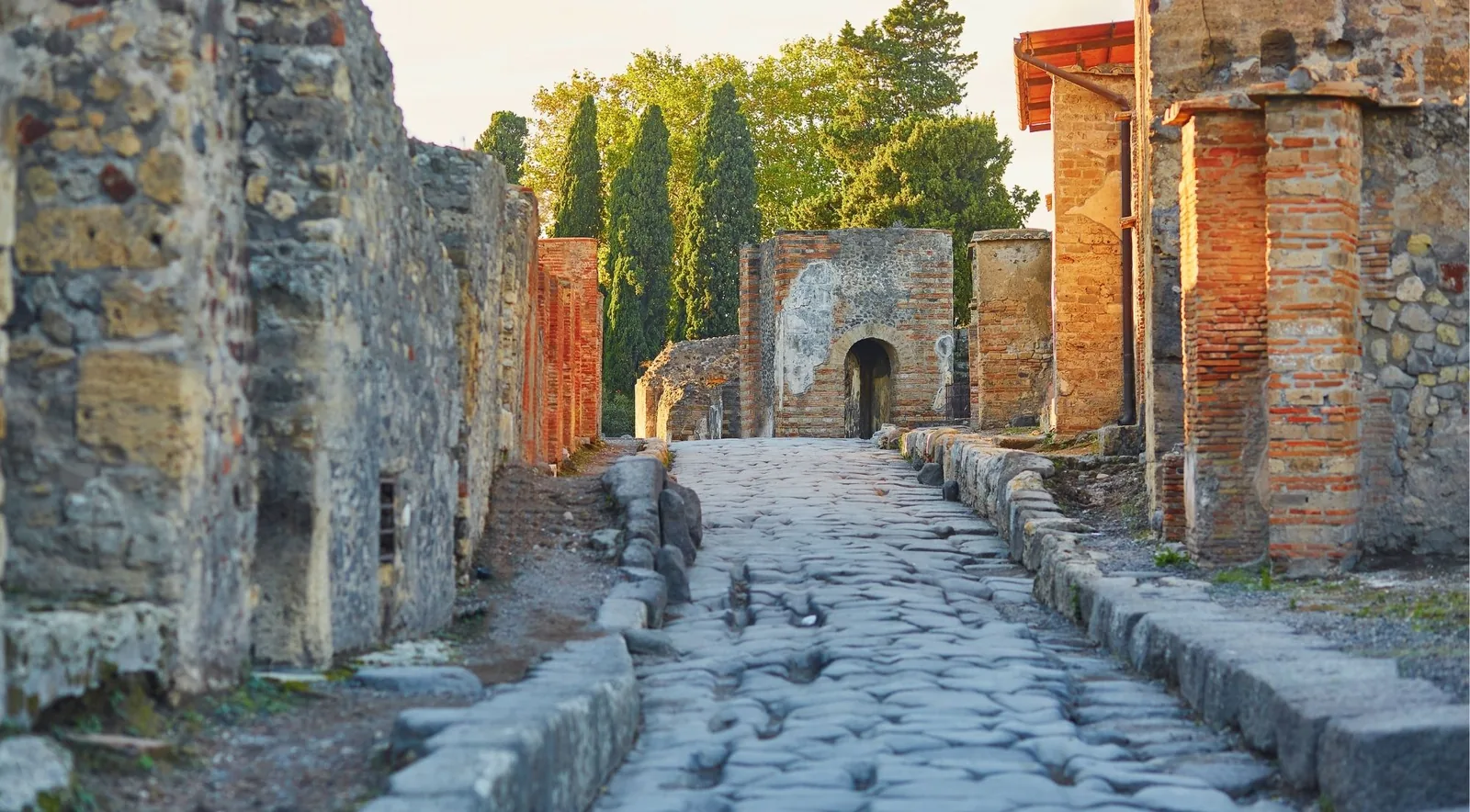
Original Roman paving
The roads are irregular volcanic blocks, many worn smooth over the centuries. Cart-wheel grooves, raised stepping stones, high kerbs and uneven thresholds can be awkward when wet.
Pompeii is usually worth visiting in light rain. Ordinary rainfall doesn't close the archaeological park, although heavy storms, dangerous winds or other safety risks can lead to restrictions or a temporary closure. Persistent downpours make the ancient paving slippery and the visit a slog, so if you have flexible days in Naples, choose a relatively dry morning.
Pompeii can be beautiful after a shower. The volcanic paving darkens, the red brick looks richer and the Forum sits under a dramatic sky. Just don't mistake atmosphere for shelter: this is mostly an outdoor city, with original road surfaces and many roofless houses. A waterproof jacket and shoes with real grip matter more here than at most city museums.
Visiting between December and February? Our Pompeii in winter guide covers the short winter hours and the holiday closures, and the best time to visit Pompeii compares rainfall month by month.
| Forecast | Our advice |
|---|---|
| Dry with a brief shower | Go, if the site is open |
| Intermittent light rain | Usually worth it with waterproof layers |
| Persistent moderate rain | Shorten the visit or choose a drier day |
| Heavy rain all day | Postpone if you can |
| Thunderstorms or official danger warnings | Follow the restrictions; don't attempt an unsafe visit |
Look at the hourly precipitation and any official warnings, not a single rain-cloud icon for the day. If this is your only chance, a two-hour visit in safe, changeable weather can still be worthwhile. If you have three more days in the Naples area, waiting usually costs little and makes the visit far more enjoyable.
When the weather turns, the National Archaeological Museum of Naples holds many of Pompeii's finest frescoes and mosaics under one roof. On a better day, the compact ruins of Herculaneum, a Mount Vesuvius crater walk, a day in Naples or a trip along the Amalfi Coast from Sorrento fill out a stay. These are tours and tickets around Pompeii.
In a storm, don't shelter under trees, and never enter closed buildings, passageways or excavation areas to get out of the rain. Listen to park staff. Lightning is a safety issue, so stay off exposed viewpoints rather than stopping for a dramatic photograph.
Usually not for ordinary showers. You can still walk many public routes and visit the interiors that are open. Individual buildings can close for safety, conservation or staffing reasons, and severe weather can disrupt the whole site. The park's own announcements are what count: a weather app can't tell you whether the gates are open. Check the official park website on the morning you go.
The roads are irregular volcanic blocks, many worn smooth over the centuries. Cart-wheel grooves, raised stepping stones, high kerbs and uneven thresholds can be awkward when wet.
Some houses keep covered rooms and the Antiquarium has museum displays, but there is no continuous indoor route. A house with frescoes may also have roofless courtyards and exposed paths in.
The Forum, the Amphitheater and the Villa of the Mysteries are a long way apart. In persistent rain, choose one compact district instead of trying to cover the whole site.
A fixed group spends time standing while the guide explains, even when you'd prefer to keep moving. A private tour can change its pace, but no guide or ticket guarantees shelter or entry to a closed building.
Pompeii's on-site exhibition space near Piazza Esedra uses finds and historical displays to explain how the city developed, the eruption and the excavations. It is properly indoors, unlike most of the remains, although it can't turn the whole visit into a sheltered one. The park recommends entering at Piazza Esedra if the Antiquarium is your first stop. Its winter hours are shorter than the park's: 9:15 AM to 4:20 PM, last entry 4:00 PM.
A first visit should include the Forum. It is outdoors, but it is the key to the city's public life and to its relationship with Vesuvius. A passing shower can make for striking photographs; move on if heavy rain or wind makes the open square uncomfortable.
The public baths show how Romans gathered, washed and socialized. Some of the accessible rooms are partly enclosed, but never treat the baths as a severe-weather shelter, and check which sections are open that day.
One of Pompeii's largest elite houses, with impressive courtyards and decorative remains. It is an important architectural stop, not a refuge: much of its surviving layout is open to the sky.
Its richly painted rooms are among the site's artistic highlights, and a must if you love frescoes. Access to the interior can be limited, and like many houses it has an earlier last entry than the park, 4:00 PM in winter. Our House of the Vettii guide has the details.
When the showers ease, carry on toward the Stabian Baths or the theaters. If the forecast is getting worse, finish with the western highlights instead of walking across the city.
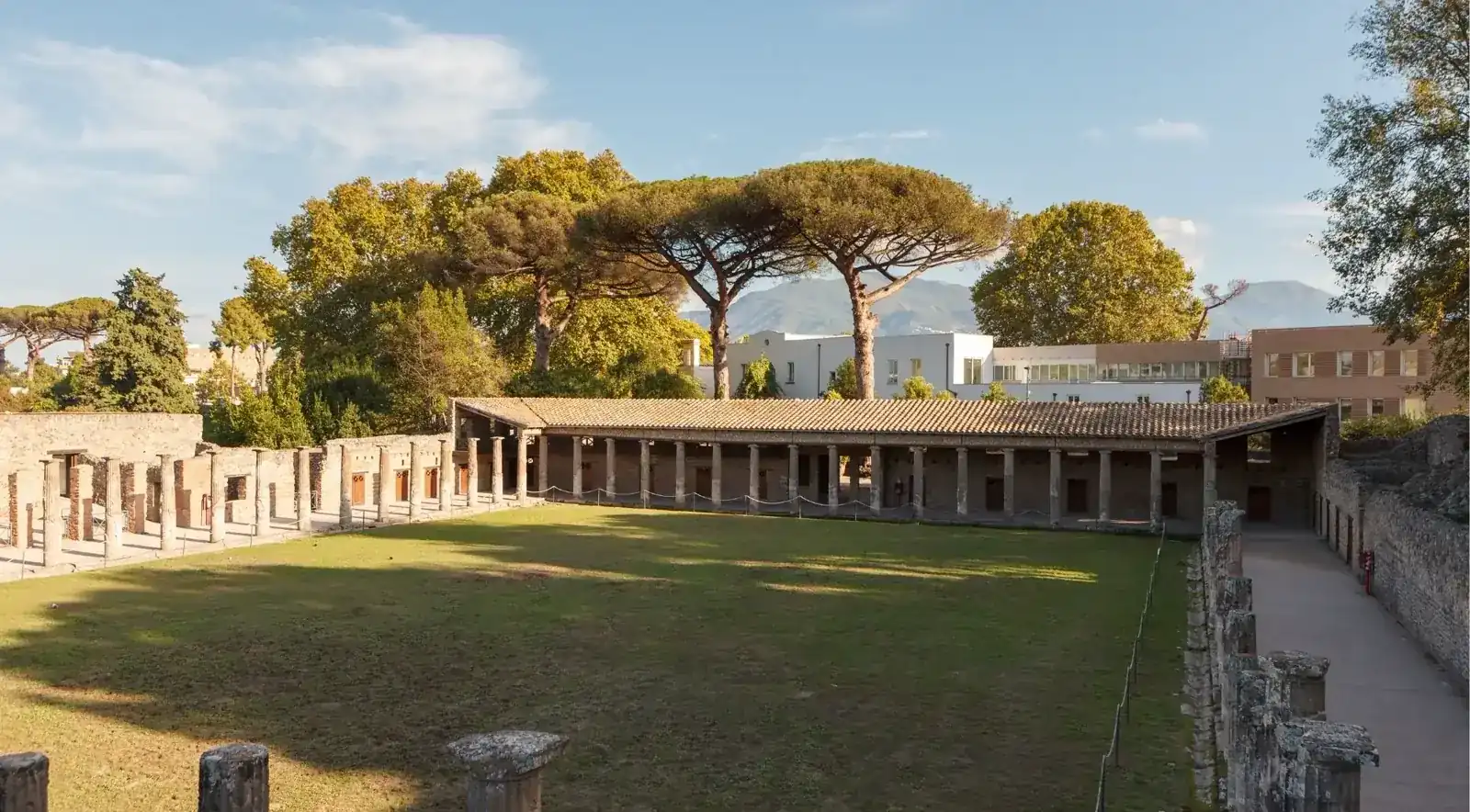
The times are estimates. They don't guarantee that every house will be open or that the path will be sheltered. Download the park's map and check the list of buildings currently open before you set off.
Wear water-resistant walking or trail shoes with good traction. They don't need to be mountain boots, but smooth leather soles, fashion sneakers with little grip and high heels are poor choices on wet ancient streets. Add pants that won't drag through puddles, layers and a rain jacket with a hood.
A compact umbrella helps in light showers. In wind, on steps or in a crowded tour group, a waterproof hood is often easier because it leaves your hands free. Bring a water bottle, tickets saved offline, a small lens cloth and a charged phone with the official map. Leave big backpacks behind: the park's regulations allow bags up to 30 × 30 × 15 cm, and anything larger goes to the left-luggage area.
Ordinary rain is not a refund reason. Official Pompeii tickets carry your name and are not refundable or transferable to another date; the park's regulations make an exception for an extraordinary closure of the site. If you stay away because the forecast looks unpleasant while the park stays open, don't expect your money back.
Commercial guided tours set their own cancellation terms. Some allow free cancellation up to a published deadline; others don't. Read the conditions for your exact product and date. An operator cancelling for safety reasons is not the same as you deciding not to go. Official tickets are sold through the park's ticket office on Vivaticket, and our Pompeii tickets guide explains each ticket type.
Independent visit. The most flexible in uncertain weather: you can shorten the route and leave when you like. You'll need the map and some reading beforehand.
Official audio guide. Good if you want explanations at your own pace. It is rented separately, at €9 for one adult.
Small-group guide. Good for first-timers who want two hours of structured explanation. Check that admission is included and whether the tour goes ahead in rain. The Pompeii Small Group Tour with an Archaeologist (4.8/5 from more than 14,000 reviews, from $38) includes the Express ticket and lets you stay on afterwards.
Private guide. Can follow your interests and change the route, but can't make Pompeii rainproof. The premium makes more sense for a family or for anyone who needs a slower pace; the Pompeii 2-Hour Private Tour (4.9/5 from 123 reviews, from $185) is one example.
For uncertain weather, our choice is a morning visit with a clear cancellation policy, or a self-guided visit bought once the forecast is more reliable. Our guide to Pompeii's winter guided tours compares group sizes and terms.
Two hours with an archaeologist and your Express entry in one booking, in groups of up to 20. A 9:00 AM start covers the Forum and the main houses in the morning, which leaves the rest of the day free if the weather turns.
Check datesFree cancellation up to 24 hours before · secure checkout via GetYourGuide
The National Archaeological Museum of Naples is the best indoor alternative if you came for Pompeii. It holds many outstanding finds from Pompeii and Herculaneum, including paintings, sculpture, household objects and mosaics, although individual galleries can close for refurbishment. A small-group museum tour with an archaeologist (on Viator, 4.8/5 from 68 reviews, from about $50) takes you through the highlights.
Herculaneum was buried in the same AD 79 eruption. It is more compact, with remarkable wood and upper floors, but it is still largely outdoors and no automatic swap in dangerous weather.
Mount Vesuvius is not a rainy-day backup. The crater walk is exposed, even more weather-dependent than Pompeii, and can close for wind, snow, ice or severe conditions. Our Mount Vesuvius tours and tickets guide explains how it works on a clear day.
With young children, keep the route short and focus on streets, fountains, shops and a few memorable houses. Expect wet thresholds and high kerbs. If you're using a stroller, look at the park's dedicated accessible route before assuming the original streets work on wheels.
The park's Pompeii for All route begins near Piazza Anfiteatro and covers selected parts of the site, but some slopes and uneven surfaces remain. If you use a wheelchair or have significant mobility needs, ask for current access advice and choose a dry day: rain makes difficult paving harder still.
Usually yes in ordinary rain, subject to the park's own restrictions and safety decisions.
Yes. There are covered displays and some roofed rooms, but no completely sheltered route through the site.
Yes in ordinary rain, although a hooded jacket is often easier in wind and on steps.
They can be. Wear shoes with good grip and slow down at thresholds, ramps and stepping stones.
Many continue in ordinary rain. Each operator sets its own weather and cancellation policy, so read the terms for your product and date.
Not with an ordinary ticket, which is valid for a single entry.
Its smaller size means less walking in the open, but it is not an indoor attraction.
Only if the weather, access and your energy allow for the extra walk outside the walls. It needs a Pompeii Plus ticket.
Go in light showers, plan a shorter visit in moderate rain, and postpone in dangerous weather. Pompeii is too extraordinary to skip because of a rain symbol, but it isn't an endurance test either. A focused, comfortable two-hour visit shows you more than five miserable hours trying to see everything in a downpour.
Checked in October 2026. This is a planning guide, not a live forecast or a closure alert.