- 15Sights ranked on this page
- 9:00Pompeii opens
- 3:30 pmLast park entry in winter
- 4:00 pmLast entry to many houses
- €20 / €25Pompeii Express / Pompeii Plus
Pompeii Is a City, Not a Museum With Fifteen Exhibits
Pompeii is what remains of a real Roman city: broad public squares, houses, workshops, baths, temples, taverns and places of entertainment spread across a big archaeological park. You walk past shop counters, painted election notices, cart ruts worn into the paving, frescoed bedrooms and the casts of people caught in their last moments. The hard part is choosing which places to see and in what order, especially with a train to catch or in the shorter November to February hours. If you would like an archaeologist to choose for you, the Entry Ticket and Guided Tour with an Archaeologist covers the Forum, the Basilica, a bath complex and several of the big houses in two hours, with the Express ticket included.
Below are 15 sights ranked, with why each one is worth the walk and how long to give it, then routes for two hours, three to four hours, and five hours or more. We also flag the places that keep their own, shorter opening hours, and the one highlight that the ordinary Pompeii Express ticket does not cover.
Before you go: Pompeii changes access to individual houses and excavation areas. On the day of your visit, check the park's live list of open buildings and the official visitor map. A landmark can be visible from the street even when its interior is closed.
When we checked on 21 November 2026, every house on this list was open. The Antiquarium, the site museum by Piazza Esedra, is not one of our fifteen: it is closed for refurbishment, with three rooms shut from 4 to 22 November and the whole museum shut from 23 November to 7 December 2026.
The 15 Best Pompeii Attractions, Ranked
| # | Highlight | Why see it | Allow | On the €20 Pompeii Express ticket? |
|---|---|---|---|---|
| 1 | Forum and Temple of Jupiter | The city's civic center and the classic Vesuvius view | 15–20 min | Yes |
| 2 | Sanctuary of Apollo | One of Pompeii's most atmospheric religious spaces | 10 min | Yes |
| 3 | Basilica | A monumental public hall beside the Forum | 10 min | Yes |
| 4 | House of the Faun | Grand private architecture and a famous mosaic history | 15–20 min | Yes |
| 5 | House of the Vettii | Exceptional frescoes around a garden courtyard | 15–20 min | Yes, when open |
| 6 | Lupanar | A small, well-documented corner of Roman city life | 5–10 min, plus any queue | Yes, when open |
| 7 | Stabian Baths | Roman heating, bathing and social routine | 10–15 min | Yes, when open |
| 8 | Via dell'Abbondanza and its shops | What everyday street life looked and felt like | 15–25 min | Yes |
| 9 | House of Menander | A richly decorated elite home | 10–15 min | Yes, when open |
| 10 | Large Theatre | A dramatic auditorium where you can picture the audience | 10–15 min | Yes |
| 11 | Amphitheatre | Pompeii's huge arena, far from the Forum | 10–15 min | Yes; access may be limited |
| 12 | Large Palaestra and casts exhibition | A vast training ground with casts and organic finds on display | 15–25 min | Yes, when open |
| 13 | Garden of the Fugitives | The human cost of AD 79, faced directly | 10 min | Yes, subject to access |
| 14 | House of Venus in the Shell | Colorful garden frescoes in a private home | 10–15 min | Yes, when open |
| 15 | Villa of the Mysteries | An extraordinary fresco cycle in a suburban villa | 45–60 min, plus the detour | No: Pompeii Plus or the upgrade |
The times are time at each stop, not walking or queuing time. Seeing all fifteen properly takes most of a day, and the villa does not fit into a fast visit. A first visit goes better when you pick your priorities than when you race between every numbered point. If you want the walking order worked out for you, our self-guided Pompeii route strings the western sights together stop by stop.
Other Experiences You Might Enjoy
If you have more days around the bay, Pompeii pairs well with the houses of Herculaneum, a crater walk on Mount Vesuvius, the finds from Pompeii at the Naples Archaeological Museum, a food or walking tour of historic Naples, or a day in Sorrento, on Capri or along the Amalfi Coast. These tours start in and around Pompeii and Naples.
1. The Forum and Temple of Jupiter: Where to Start
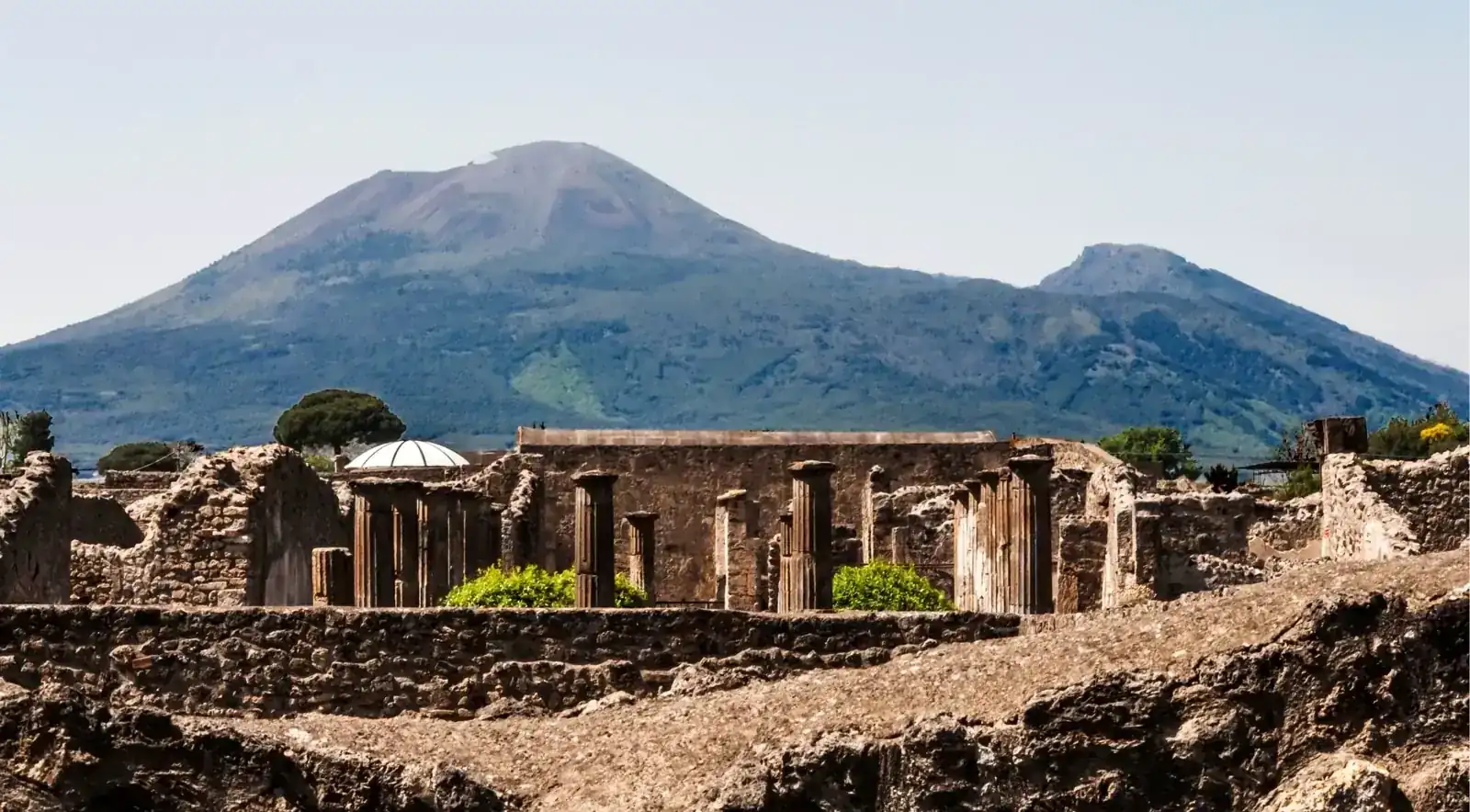
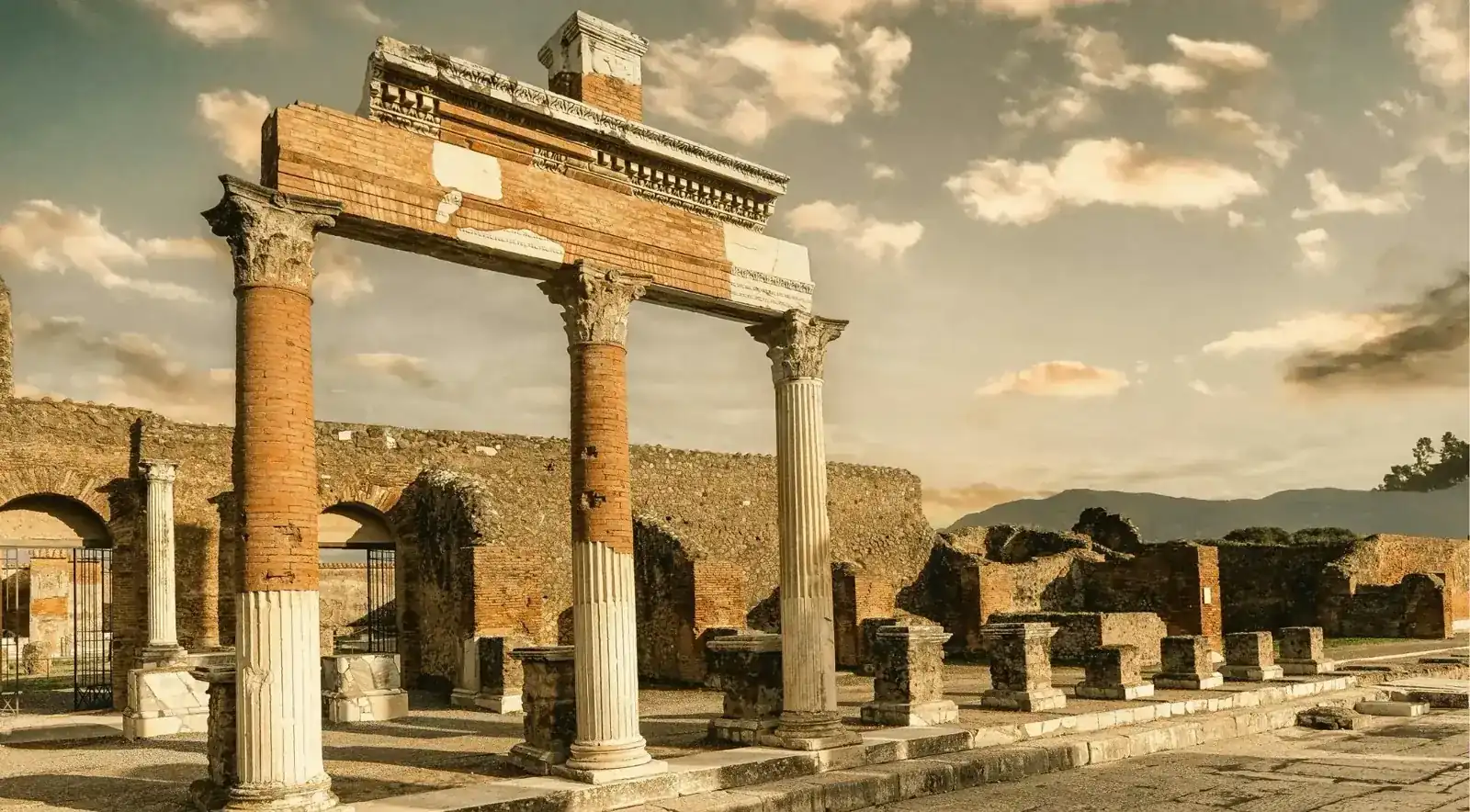
The Forum was the public and ceremonial heart of Pompeii. Stand in this long, open square and the city's layout starts to make sense: temples and public buildings around a shared space, trade close by, and streets running off into the residential districts. The surviving columns, paving and building outlines tell you more about Pompeii as a complete city than any single object.
At the northern end stands the Temple of Jupiter, dedicated to the principal gods of the Roman state. Look past it to Mount Vesuvius. On a clear day this is one of the great views at Pompeii, with the volcano that buried the city still filling the skyline.
What to look for: the length of the square, the monumental approaches, and how the Forum relates to the civic and religious buildings around it. Picture traders, magistrates, worshippers and ordinary residents all using the same space for very different reasons.
Best for: everyone, first-time visitors and photographers above all. Allow: 15–20 minutes. Route tip: reach the Forum soon after entering at Porta Marina or Piazza Esedra, before you head off to the houses.
2. Sanctuary of Apollo: One of the City's Oldest Sacred Places
A few steps from the Forum, the Sanctuary of Apollo feels quite different from the open civic square. Its colonnade, altar and surviving architecture show how religious life was woven into the city center. The sanctuary grew over centuries, so it also shows how long Pompeii had existed before the eruption of AD 79.
Its position matters as much as its looks. You can see how a place of worship sat in the flow of people through the main public district. The columns frame good photographs, especially when the site is quiet.
What to look for: the colonnades, the altar area and the sanctuary's relationship with the Forum next door. Best for: history lovers and anyone curious about Roman religion. Allow: about 10 minutes. It is an easy addition to even a two-hour visit.
3. The Basilica: The Scale of Pompeii's Public Life
Pompeii's Basilica, on the southwest side of the Forum, was a grand public building used for civic and legal business. Long before the word came to mean a church, a basilica was a type of Roman public hall, and this one shows how administration and the courts fitted into everyday life.
Its open plan, columns and surviving footprint work best straight after you cross the Forum, because you can compare a vast roofed civic building with the open square outside. It is also a reminder that Pompeii was a prosperous, working town, not just a collection of villas.
What to look for: the long central space, and how the surviving supports hint at the building's original height. Best for: architecture and urban-history fans. Allow: 10 minutes. It pairs naturally with the Forum and the Sanctuary of Apollo and adds very little walking.
4. House of the Faun: The Grandeur of Wealthy Pompeii
The House of the Faun (Casa del Fauno) is one of Pompeii's most famous homes, and its sheer size makes the gap between ordinary housing and elite luxury obvious at once. You move through a sequence of entrances, courtyards and open spaces designed to impress visitors nearly two thousand years ago.
The house takes its modern name from a bronze statue of a dancing faun. Its most celebrated find was the Alexander Mosaic, showing Alexander the Great in battle with Darius III. The original went to the National Archaeological Museum in Naples, so don't expect to see it on the floor here, and the museum says it is currently being restored and is not on display. The layout of the house is the real reason to stop.
What to look for: the size of the courtyards, the carefully planned sightlines, and the contrast with the narrow streets outside. Best for: a first visit, and especially rewarding with an archaeologist who can explain how a rich household was arranged. Allow: 15–20 minutes. It sits in the western part of the site, close to the other big houses. In winter the park lists it open 9:00 a.m. to 5:00 p.m.
Want the history explained, not just the buildings named? Compare the options in our Pompeii guided tours guide and our archaeologist-led tour review.
5. House of the Vettii: Pompeii's Most Unforgettable Painted Rooms
The House of the Vettii (Casa dei Vettii) is the perfect contrast to the House of the Faun. It is famous for its rich wall paintings and the decorated rooms around its garden courtyard, and it shows how myths and stories were used to give a home its character. It reopened in January 2023 after a restoration of around 20 years, which makes it one of the strongest reasons to visit Pompeii now.
Its owners are usually identified as two men named Vettius, wealthy freedmen who used art, architecture and decoration to show off their new status. The decoration is elaborate, sometimes playful and occasionally explicit, a reminder that Roman domestic imagery does not always match modern expectations. Look for the Priapus fresco by the entrance, the strongboxes in the atrium, the restored peristyle garden, and the frieze of tiny winged cupids working as goldsmiths, perfumers, fullers, winemakers and charioteers.
What to look for: the garden-centered plan, the mythological scenes, and how the decoration changes from room to room. Best for: art lovers, adults, photographers and anyone curious about Roman home life. Allow: 15–20 minutes, longer if you want to study individual frescoes.
Access warning: the park lists the interior open from 9:15 a.m. to 4:20 p.m. in winter, with last admission at 4:00 p.m., subject to change. Get here before late afternoon. For more detail, see our House of the Vettii guide.
6. The Lupanar: A Small Building With a Larger Social Story
The Lupanar, Pompeii's best-known brothel, draws attention because its purpose is unusually clear. Small rooms, built-in furnishings and wall paintings give it an immediacy that many bigger buildings lack. It also opens up the less glamorous side of Roman society, including exploitation and very unequal power.
The building is tiny, so the visit is short even when getting in takes several minutes, and it gets crowded when a few groups arrive together. Some of the paintings are sexually explicit; families may want to explain the context first or skip the interior.
What to look for: the cramped rooms and how they are arranged, more than the paintings as a novelty. Best for: adults and anyone interested in everyday city history. Allow: 5–10 minutes once inside, more if there is a queue. Route tip: combine it with the Stabian Baths and the central streets nearby.
The park's winter list gives interior access from 9:15 a.m. to 4:20 p.m., last admission 4:00 p.m., which can change.
7. Stabian Baths: How Romans Relaxed, Washed and Socialized
Pompeii's Stabian Baths show the engineering and routine behind Roman bathing. A bath complex was much more than a place to get clean: it was part of the city's social life. Rooms at different temperatures led from one to the next, and a clever heating system made it all work.
Notice how the room sizes change as you move from cooler to warmer spaces. Even alone you can picture bathers moving through the building, though a good guide makes the heating and the social habits much easier to follow.
What to look for: the sequence of bathing rooms, the surviving architectural detail and the traces of the heating technology. Best for: families with older children, engineering-minded visitors and anyone interested in daily life. Allow: 10–15 minutes. The park's winter list includes the male section, open 9:15 a.m. to 4:20 p.m. with last entry at 4:00 p.m., an hour before the park closes.
8. Via dell'Abbondanza: Streets, Shops and Ordinary Life
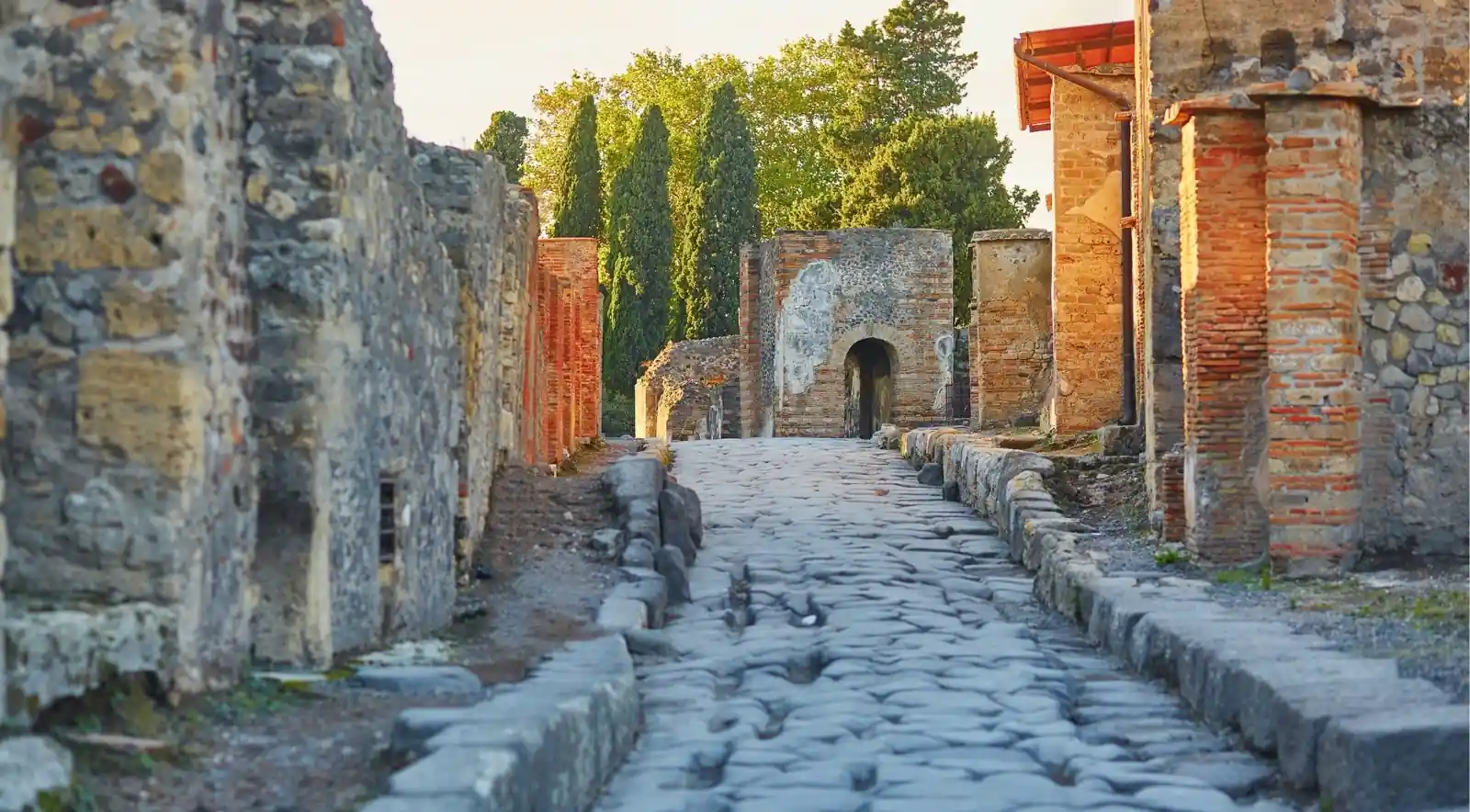
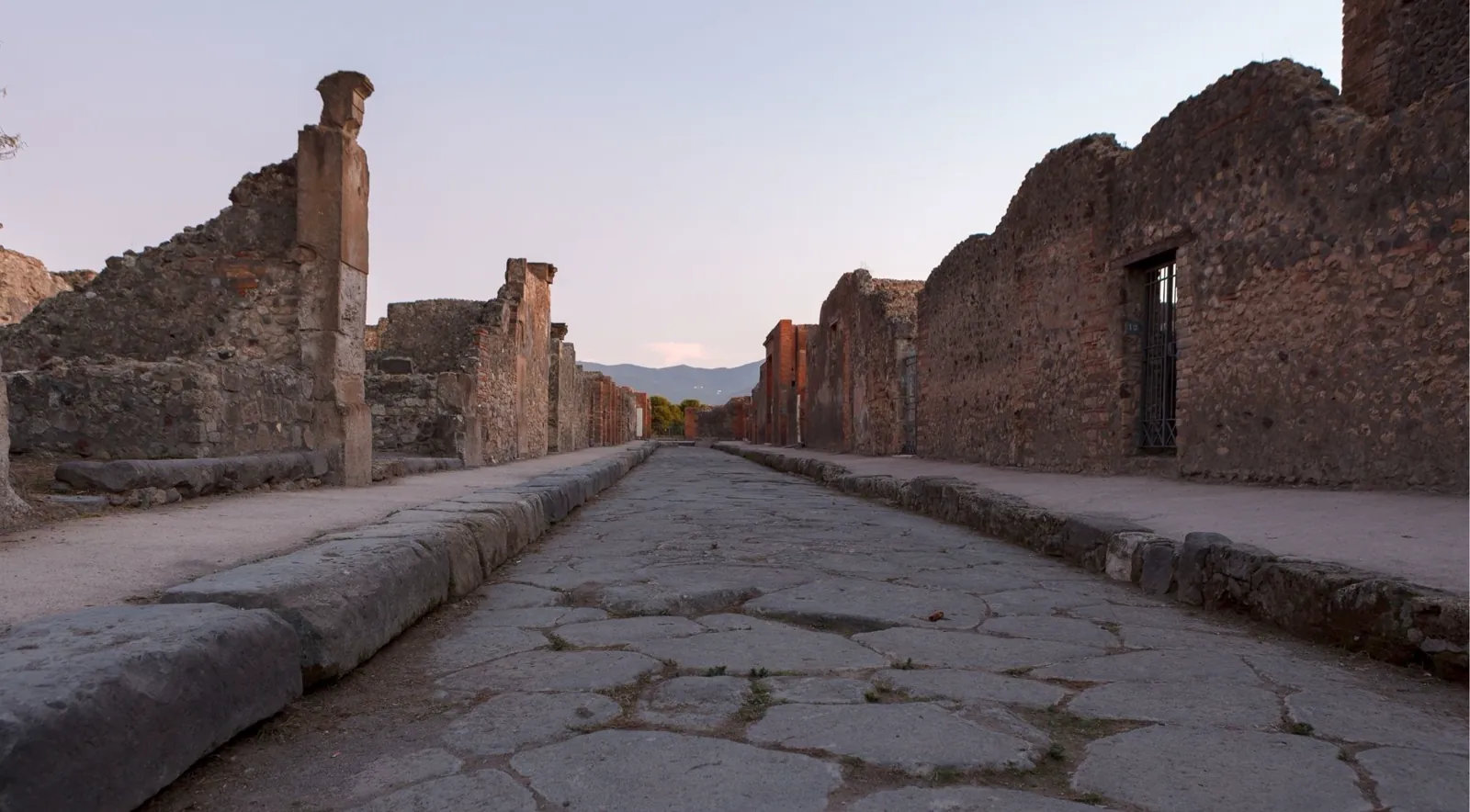
Not every great sight in Pompeii is behind the door of a famous house. Via dell'Abbondanza, one of the city's main streets, shows you what moving through Pompeii was actually like. Stone paving, house fronts, thresholds and the remains of shops make the ruins feel like a town.
Stop at the stepping stones that let pedestrians cross the street, at the shopfronts that opened straight onto the pavement, and at the election slogans painted on the walls. Think about how carts, pedestrians and street traders shared these narrow spaces. A thermopolium, a counter selling hot food and drinks, is one of Pompeii's distinctive kinds of shop, but not every one can be entered.
What to look for: wheel-worn paving, street crossings, fountains and ground-floor shop architecture. Best for: visitors who want to feel the size of the city, not just see the headline monuments. Allow: 15–25 minutes, spread across a longer walk. The Regio V thermopolium, the one you see in photographs online, is listed by the park as visible from outside, not open for an interior visit.
The streets are one of the best arguments for a slower visit. If you are walking without a guide, our Pompeii visiting guide has more orientation and planning advice.
9. House of Menander: An Alternative to the Busiest Mansions
The House of Menander (Casa del Menandro) is a richly decorated home that fills out the picture you get from the Faun and the Vettii. It is named after a painting of the Greek playwright Menander. With its inner courtyard and painted rooms, it is another chance to see how Pompeii's elite used architecture and images to show taste and status.
If the House of the Vettii is crowded or closed, the House of Menander is a satisfying alternative, with its own character as a wealthy home. It also sits naturally on a route from the central streets to the theaters.
What to look for: how the living spaces are arranged around the courtyard, and the surviving wall decoration. Best for: visitors with three hours or more who want to see more than one kind of house. Allow: 10–15 minutes. The park's winter list gives access from 9:15 a.m. to 4:20 p.m., last entry 4:00 p.m., subject to change.
10. The Large Theatre: Picture a Roman Audience
The Large Theatre (Teatro Grande) is one of the easiest places in Pompeii to imagine full of people. The curved seating and the stage make the building's purpose obvious, and it is a welcome change from frescoes, temples and shops.
The theater district also includes the Small Theatre, or Odeion, though access to particular areas varies. The big quadriporticus next door is worth noticing while you are there. The Large Theatre makes a good final stop on a western-side visit, or a waypoint on a longer walk east.
What to look for: the slope of the seating, the size of the stage area and how close the audience sat to the performers. Best for: families, photographers and anyone interested in Roman entertainment or architecture. Allow: 10–15 minutes. In winter it is listed open 9:00 a.m. to 5:00 p.m. With only two hours, this is a better choice than the long trek to the Amphitheatre.
11. The Amphitheatre: A Major Landmark, Not a Quick Detour
Pompeii's Amphitheatre is in the eastern part of the site, a long walk from the Forum district in the west. It is one of the oldest surviving permanent Roman amphitheaters, and it shows that the city could stage big public spectacles long before the Colosseum in Rome was built.
The great oval and its steep banks of seating explain how the arena and its crowds worked. Its distance is what matters for planning, though: it does not belong on a rushed western highlights loop unless you are willing to drop several other stops.
What to look for: the footprint of the arena and the structure of the seating. Best for: visitors with three to five hours, Roman-history fans and anyone leaving by Piazza Anfiteatro. Allow: 10–15 minutes, plus the long walk across the site.
Current access note: the park's open-buildings list says that since 14 June the Amphitheatre can be viewed only from its southern entrance. Check the arrangement on the day; don't expect to walk through every part of the structure.
12. Large Palaestra: Exercise Ground, Exhibition and the Human Side of the Eruption
Opposite the Amphitheatre is the Large Palaestra (Palestra Grande), a huge enclosure used for exercise and the training of young men. Its scale is worth seeing in itself, but for many visitors the draw is the park's permanent exhibition of plaster casts and organic finds.
The displays show sides of the eruption you can't read from the streets. The casts are not sculptures: they were made by filling the hollows that bodies left in the volcanic deposits after they decayed. The mix of personal tragedy and physical evidence makes this an emotional stop.
What to look for: the vast courtyard, and how the casts and objects are laid out. Best for: visitors who want the history of AD 79, families with older children and visitors drawn to the eruption itself. Allow: 15–25 minutes; check that the exhibition is open. The park's winter list gives the Palaestra interior 9:15 a.m. to 4:20 p.m., last entry 4:00 p.m.
13. Garden of the Fugitives: The Tragedy Behind the Ruins
The Garden of the Fugitives (Orto dei Fuggiaschi) is one of the most moving places in Pompeii. The casts of people overtaken by the eruption bring the disaster into sharp focus, and after the wealthy houses and busy public spaces it becomes hard to think of the city only as architecture.
The visit is usually quiet and short, and it deserves a respectful approach. Don't guess at who the victims were or how they were related; think about what the evidence can and cannot tell us. Interpretations of the casts have changed as new methods, including DNA analysis, have been applied.
What to look for: where the casts lie within the garden and how they relate to the excavated setting. Best for: adults and older children ready for a difficult subject. Allow: about 10 minutes. It fits a route heading to the eastern part of the site much better than a short Forum-only visit. In winter it is listed open 9:00 a.m. to 5:00 p.m.
14. House of Venus in the Shell: A Colorful East-Side Highlight
The House of Venus in the Shell (Casa della Venere in Conchiglia) is famous for its painted garden wall showing Venus reclining in a seashell. After the monuments of the Forum and the Amphitheatre, this domestic setting feels intimate and full of color. It shows how Pompeians used painting to transform a home and conjure imaginary landscapes.
If you have crossed the site toward the Amphitheatre, this house adds variety without sending you back west. It is also proof that striking frescoes were not limited to the famous mansions near the Forum.
What to look for: the garden painting, its setting and its tricks of perspective. Best for: art lovers and anyone finishing an east-side route. Allow: 10–15 minutes. The park's winter list gives interior hours of 9:15 a.m. to 4:20 p.m., last entry 4:00 p.m.; access can change.
15. Villa of the Mysteries: Pompeii's Greatest Optional Extra
The Villa of the Mysteries (Villa dei Misteri) is among the most extraordinary places at Pompeii. It stands outside the walls of the ancient city, and it is best known for a fresco cycle that runs around the walls of one important room. The paintings are often linked to the rites of Dionysus, though what the scenes mean exactly is still debated.
Slow down here. The paintings reward following the figures around the room one by one; a quick photograph misses most of it. The villa also shows a different side of life, away from the crowded streets of the town.
The ticket detail that matters: the €20 Pompeii Express ticket does not include the Villa of the Mysteries. The €25 Pompeii Plus ticket covers the suburban villas route. The park also sells an €8 upgrade from Express, card payment only, at the route entrance near Porta Ercolano (the Herculaneum Gate), so deciding on the day costs €28 against €25 for Plus bought at the start. These are the prices published for tickets from 12 January 2026; recheck before you buy.
Best for: fresco lovers, repeat visitors and anyone with at least three to four hours for a western route that ends at the villa (five hours or more if you also want the eastern city). Allow: 45–60 minutes at the villa, plus the extra walk. In winter the park lists the villa open 9:15 a.m. to 4:30 p.m., last entry 4:15 p.m., but the last access through Porta Ercolano is at 3:30 p.m. Don't leave this stop for the end of a late-afternoon visit.
For help deciding whether the extra ticket is worth it, see Pompeii tickets explained. Our full guide to the Villa of the Mysteries covers the frescoes, the route and the winter cut-off. If you'd like an archaeologist to take you there, the 3-hour Villa of Mysteries tour with an Archaeologist includes the Pompeii Plus ticket (from US$58 per person; 4.8/5 from more than 1,400 reviews on GetYourGuide).
Which Pompeii Highlights to Choose if You Have Limited Time
Most visitors should not try to fit in all fifteen. The best plan depends on how long you have, which entrance you use and how much of the site you want to walk.
Only 2 hours: stay in the western core
Suggested route: Porta Marina → Sanctuary of Apollo → Forum and Temple of Jupiter → Basilica → House of the Faun → House of the Vettii, if open and not busy → Lupanar or Stabian Baths → out through the nearest open gate.
This is a deliberately selective route: two great public spaces, one or two houses and one glimpse of daily life. If you like to photograph every building, cut it to five or six stops.
Skip: the Amphitheatre, the Palaestra, the Garden of the Fugitives, the House of Venus in the Shell and the Villa of the Mysteries. They deserve time of their own, not a rushed round trip.
3–4 hours: the best first-time route
Suggested route: Porta Marina → Sanctuary of Apollo → Forum → Basilica → House of the Faun → House of the Vettii → Lupanar → Stabian Baths → Via dell'Abbondanza → House of Menander or Large Theatre → on east to the Garden of the Fugitives or the Amphitheatre and Palaestra → out at Piazza Anfiteatro.
Treat this as a flexible cross-site plan; it is not a promise that every interior will be open. Check the park map first; you may reorder the central houses to avoid doubling back. Depending on how many interiors you enter, the distance and your breaks, the full eastern extension can take you past four hours.
If you start late: drop the Palaestra and the Garden of the Fugitives, or spend the afternoon in the central and western areas. This matters most in winter, when several houses stop admitting visitors at 4:00 p.m. although the park stays open until 5:00 p.m.
5–6 hours: add the villa or see the eastern city properly
With a long day, choose one of two upgrades.
Option A, art and frescoes: start with the Forum and the western houses, take the Porta Ercolano route out to the Villa of the Mysteries, then come back into the city. Make sure you have a Pompeii Plus ticket or are ready to buy the upgrade, and reach the suburban villas checkpoint before 3:30 p.m. in winter.
Option B, the whole city: start in the western civic center, follow Via dell'Abbondanza, see the theater district, the Garden of the Fugitives, the House of Venus in the Shell, the Large Palaestra and the Amphitheatre, then leave by Piazza Anfiteatro. Choose this if you want to understand Pompeii as a city; choose Option A if the frescoes are what you came for.
Five or six hours still does not guarantee that every house will be open. Weather, opening changes, queues and breaks will reshape the route. Our full guide to visiting Pompeii has more background.
Pompeii: Entry Ticket and Guided Tour with an Archaeologist
The most-reviewed guided walk at Pompeii, and the easiest way to cover the two-hour core without planning it yourself. Askos Tours meets you outside Porta Marina, the Pompei Express ticket is included, and the archaeologist takes a small group of up to 20 through the Forum, the Basilica, a bath complex, bakery and thermopolium counters and a selection of the big houses. Headsets are provided for groups of 10 or more; our full review explains the headset and late-start complaints that turn up in the lower-rated reviews. You can stay on and explore after the tour ends.
Check tour datesFree cancellation up to 24 hours before · price in US dollars on GetYourGuide, checked 3 September 2026; the live price is on the booking page
Best Route Map and Entrance Choice
Look at the park's official Pompeii map and downloadable visitor guide before you arrive. Save it to your phone and mark your must-see stops; mobile reception inside the site is no substitute for a map you can open offline.
The three main visitor entrances are:
- Porta Marina: the natural start for a Forum-first route, especially if you arrive at Pompei Scavi–Villa dei Misteri station on the Circumvesuviana.
- Piazza Esedra (Porta Marina Inferiore): another western entrance, handy for the theater area and nearby transport.
- Piazza Anfiteatro: useful if you want to start with the Amphitheatre and the eastern districts, or follow the park's accessible route.
Before you commit to a one-way route, check which gate you want to leave by and how you are getting home. A west-to-east crossing is efficient on site, but it can leave you a long way from the station you arrived at. Our Pompeii entrances comparison explains the trade-off in detail.
An ordinary ticket normally allows only one entry. Don't plan to go out for lunch and come back later without checking the conditions of your ticket.
What Ticket Do You Need to See Pompeii's Highlights?
| Ticket | Standard adult price* | What it covers on this list | Best for |
|---|---|---|---|
| Pompeii Express | €20 | Every sight in the main ancient city, subject to access; not the Villa of the Mysteries | Most 2–4 hour visits |
| Pompeii Plus | €25 | The main ancient city and the suburban villas route, including the Villa of the Mysteries | Fresco lovers and longer visits |
| Great Pompeii three-day ticket | €30 | Pompeii Plus plus the participating nearby archaeological sites, under the ticket's conditions | Travelers planning several archaeological visits |
*Official prices published for tickets from 12 January 2026, checked on pompeiisites.org on 21 November 2026. Concessions and free admission may apply; check the current conditions, not a reseller's headline price.
Tickets are nominative, and the park caps the number of visitors each day. The official seller is Vivaticket, through the park's booking page.
Our advice: buy Express if your priorities are the Forum, the houses, the baths, the theaters and the Amphitheatre. Buy Plus at the start if the Villa of the Mysteries is genuinely on your must-see list, and don't pay extra for a villa visit you won't have time to make.
On guided visits, read the inclusions carefully: guided tour does not always mean entry ticket included, and the ticket type decides whether the suburban villa is covered. The 3-hour Villa of Mysteries tour with an Archaeologist is one of the few that includes Pompeii Plus.
Compare Pompeii ticket options · Compare Pompeii tour prices
Is It Better to See Pompeii With a Guide or Independently?
Go independently if you enjoy wandering, already like Roman history and want full control of your day. A map and a short list of highlights are enough for a rewarding visit. Without context, though, many buildings look alike, Pompeii has little explanatory signage, and it is easy to walk past important details without noticing them.
Choose a small-group archaeologist-led tour if this is your first visit, you have only two or three hours, or you want the frescoes, daily life and the eruption explained properly. A well-planned route tells you why each ruin matters, not just what it is. Check that the meeting point suits your arrival station and that the entry ticket is included or clearly priced on top.
Choose a private tour if you are traveling with children, have a particular interest in art or architecture, or want to set your own pace and priorities. Private guides cost more overall, but the group price can work out competitive for a larger family, so compare the total, not the per-person headline.
| Our pick on GetYourGuide | Style | Length | Pompeii entry | From |
|---|---|---|---|---|
| Entry Ticket and Guided Tour with an Archaeologist | Small group, up to 20 | 2 hours | Express ticket included | US$34 per person; 4.8/5 from more than 25,000 reviews |
| Small Group Tour with an Archaeologist | Small group, 2- or 3-hour option | 1.5–3 hours | Express ticket included | US$38 per person; 4.8/5 from more than 14,500 reviews |
| Exclusive Tour with Archaeologist and Entry Tickets | Small group or private slot, meets at Porta Marina | 2 hours | Express ticket included | US$49 per person; 4.9/5 from more than 890 reviews |
| 3-hour Villa of Mysteries tour with an Archaeologist | Small group, adds the villa | 3 hours | Pompeii Plus ticket included | US$58 per person; 4.8/5 from more than 1,400 reviews |
| Private Family Tour with an Archeologist Guide | Private, family-paced | 2–3 hours | Only as an extra at checkout | US$347 per group of up to five; 4.8/5 from more than 260 reviews |
Prices in US dollars on GetYourGuide, checked 3 September 2026; ratings checked 21 November 2026. The live price is on the booking page.
For full comparisons, see guided Pompeii tours, private Pompeii tours and our self-guided Pompeii route.
Seeing Pompeii in November, December, January or February
Winter is a good time to enjoy Pompeii's streets and open squares without the summer heat. The trade-off is shorter hours, more rain and earlier closing at individual houses.
Official winter hours (15 October to 15 March): the park opens at 9:00 a.m., takes its last visitors at 3:30 p.m. and closes at 5:00 p.m. It normally closes on 25 December and 1 January unless a special opening is announced. Individual houses keep shorter hours: the House of the Vettii, the Lupanar, the Stabian Baths, the House of Menander, the House of Venus in the Shell and the Large Palaestra all take their last visitors at 4:00 p.m.
In November and December, pack a water-resistant jacket, check the forecast and see the frescoed interiors while they are open. In January and February, start early even on quiet days: the low winter sun makes the Forum beautiful, but the afternoon goes fast. Ancient paving is slippery when wet.
If the rain gets heavy, shorten the route and stick to the interiors that are open; don't try to cross the whole city. Pompeii is an outdoor site with no fully sheltered circuit, and the famous houses are not guaranteed to stay open in every condition.
Antiquarium closed until 7 December 2026: the park announced on 3 November that the Antiquarium would close in two phases for refurbishment of its exhibition spaces. From 4 to 22 November three rooms are closed ("Living in Luxury", "A fundamentis reficere" and "The Last Day"); from 23 November to 7 December the whole museum is closed. It is not one of our fifteen, but check the park's notices if you planned to include it.
More detail: Pompeii in November, Pompeii in December, Pompeii in January, Pompeii in February, Pompeii in the rain and the full winter opening hours.
Practical Tips for Seeing the Main Attractions
- Start with a shortlist, not the whole map. Star five sights you won't miss and treat the rest as a bonus.
- Wear shoes with grip. The ancient roads have uneven stones, steps, ruts and changes of level, and wet stone is slippery.
- Check each building's status. The House of the Vettii, the Lupanar, the baths and other frescoed houses can have earlier last entry or temporary closures while the streets stay open.
- Travel light. Bags larger than 30 × 30 × 15 cm are not allowed in. Paid storage is available at certain entrances, so check the facilities before arriving with suitcases.
- Bring water and take proper breaks. There are drinking fountains and refreshment points, but don't count on food along every part of your route, and eating is allowed only in designated areas.
- Use the official map. It shows entrances, accessible paths, toilets and drinking fountains as well as the famous buildings.
- Plan your exit as carefully as your entrance. Finishing at Piazza Anfiteatro changes your journey back to Naples or Sorrento compared with leaving through Porta Marina.
- Respect the remains. Don't touch the frescoes or climb the walls. Personal photography is generally allowed without flash or tripod; professional and commercial shoots need permission.
- Don't promise children every stop. Two hours with a few vivid sights is usually more fun than an exhausting attempt at the whole park. Our Pompeii with kids guide has a family route.
- Don't confuse the modern town with the archaeological park. Modern Pompei has hotels, shops and stations; the excavated Roman city has its own entrances and long walking distances inside.
Frequently Asked Questions About What to See in Pompeii
What are the absolute must-see sights in Pompeii?
For most first-time visitors, the essential five are the Forum, the House of the Faun, the House of the Vettii, the Stabian Baths and the Large Theatre. Between them you get public life, private wealth, art, Roman engineering and entertainment. Add the Garden of the Fugitives or the casts exhibition in the Large Palaestra if the human story of the eruption is what draws you.
What is the single most famous thing in Pompeii?
There is no single agreed answer. The Forum with Mount Vesuvius behind it is the most recognizable view, while the House of the Faun, the House of the Vettii, the Lupanar and the plaster casts are the attractions people talk about most. Which matters most depends on whether you came for art, archaeology or the story of AD 79.
Can I see the best of Pompeii in two hours?
Yes, an excellent selection, if you stay mainly in the western core. You cannot see the whole city. Prioritize the Forum and the Sanctuary of Apollo, one major house, the Stabian Baths or the Lupanar, and perhaps the theater area. Leave the Amphitheatre and the Villa of the Mysteries for a longer visit.
Is three hours enough for Pompeii?
Three hours gives you a strong introduction: several headline sights and a little time to wander. It is still too short to see everything on this list comfortably. Follow one main route, and don't count on getting into every painted house, because queues and temporary closures affect access.
Can you visit the House of the Vettii?
Yes. When we checked on 21 November 2026, the House of the Vettii was on the park's list of visitable buildings, open 9:15 a.m. to 4:20 p.m. with last entry at 4:00 p.m. in winter. Access can change for maintenance, staffing or conservation, so check the official open-buildings list before you go, and treat any tour's list of stops as subject to change.
Where can I see the plaster casts in Pompeii?
The park lists a permanent exhibition of casts and organic finds in the Large Palaestra. The Garden of the Fugitives is the other key place for understanding the victims of the eruption. Displays and viewing arrangements can change, so check the site map and current notices.
Are the original mosaics still in Pompeii?
Some mosaics and decorated floors are still in place at Pompeii, but many of the important portable finds went to museums for safekeeping. The original Alexander Mosaic from the House of the Faun belongs to the National Archaeological Museum of Naples, which says it is being restored and is not on display at the moment. Check its status before making a special trip to see it.
Is the Villa of the Mysteries included in a normal Pompeii ticket?
Not in the €20 Pompeii Express ticket. The €25 Pompeii Plus ticket includes the suburban villas route. The park also sells an €8 upgrade from Express, card payment only, at the route checkpoint near Porta Ercolano. Check the official ticket table when you book.
Is the Amphitheatre close to the Forum?
No. The Amphitheatre is at the eastern edge of the site and the Forum is in the western civic center, so walking between them is a proper cross-city trek. With only two hours, stay in the Forum and the residential streets unless the arena is your top priority.
What is better, Pompeii or Herculaneum?
Pompeii gives you a much larger cityscape and far more public monuments; Herculaneum is compact and preserves some features of its houses, such as woodwork and upper floors, in ways Pompeii does not. A full day can cover both, but each needs planning. Compare the two in our Pompeii vs Herculaneum guide.
What is the best entrance for the main Pompeii sights?
For a Forum-first route, Porta Marina is the convenient gate. For the Amphitheatre and the eastern accessible route, Piazza Anfiteatro is the better choice. Piazza Esedra is another western entrance. Choose by your transport, your route and where you want to come out, not by a rule that one gate is always best.
Is the Forum free to visit once I enter Pompeii?
Yes. The Forum is part of the main ancient city covered by ordinary admission, and there is no separate Forum ticket. The one highlight in this guide that needs more than the Express ticket is the Villa of the Mysteries.
Can I visit Pompeii in winter and still see the highlights?
Yes. The Forum, the streets and most of the attractions stay visitable in winter, subject to the usual access changes and the weather. The difference is the 9:00 a.m. to 5:00 p.m. park schedule, last park entry at 3:30 p.m., and earlier last entry at several houses. Arrive in the morning and keep a shorter plan ready in case it rains.
Is Pompeii suitable for children?
Yes, especially for children who like history, buildings, volcanoes and stories about daily life. The uneven ground is tiring, and some places, including the Lupanar and the casts of eruption victims, need an age-appropriate explanation. Shorter routes usually work better with younger children; see our Pompeii with kids guide.
Can wheelchair users see the top Pompeii attractions?
Partly. The park has a designated accessible route, Pompeii for All, usually started from Piazza Anfiteatro, but not every house and street on this list can be reached independently. The ancient terrain has big changes of level and uneven surfaces. Plan with the official accessible-route map, and don't assume every stop here is reachable.
Is a guided tour worth it for the highlights?
Often, especially on a short first visit. Pompeii has little explanatory signage, and a good guide connects the buildings to Roman history, explains the paintings and points out details you would walk past. If you enjoy exploring at your own pace, a well-chosen route works too. Compare the total cost and check whether admission is included.
Final Verdict: What Should You Not Miss?
If you remember one thing, make it this: see Pompeii as a city, not a checklist. Start in the Forum, go inside at least one beautifully decorated house, look closely at daily life in the baths and the streets, and finish somewhere that shows either the scale of Roman public life or the human cost of the eruption.
For most people that means three to four hours, an early start and a route that suits the entrance you actually use. If the Villa of the Mysteries is the reason you are going, give it proper time and buy the right ticket. Otherwise the standard ancient-city ticket covers more remarkable sights than you can fit into one short visit.
If you'd like someone to choose and explain the stops, the Entry Ticket and Guided Tour with an Archaeologist covers the western core in two hours and leaves you free to carry on east afterwards.
Plan the next step: compare Pompeii guided tours · understand Pompeii's ticket options · get to Pompeii from Naples
Official Sources and Last-Checked Information
Opening hours, open buildings, ticket prices and the Antiquarium notice checked on the park's website on 21 November 2026. House hours, ticket prices and access arrangements can change without notice. GetYourGuide ratings checked 21 November 2026; prices are as stated under each table.
- Timetables and tickets (Pompeii Archaeological Park): prices from 12 January 2026, suburban villa access, daily visitor limits and winter hours
- Open buildings (Pompeii Archaeological Park): access to the houses, theaters, casts exhibition and Amphitheatre
- Map and guide to the excavations (Pompeii Archaeological Park): entrances, routes and facilities
- Visitor services (Pompeii Archaeological Park): bag limits and storage, toilets, refreshments and audio guides
- Regulations for visitors (Pompeii Archaeological Park): access, photography, conduct and safety
- Service announcements (Pompeii Archaeological Park): temporary openings and closures, including the Antiquarium works from 4 November to 7 December 2026