1. Arriving after lunch with a long list
Last entry is 3:30 PM, but the best time to start is the morning.
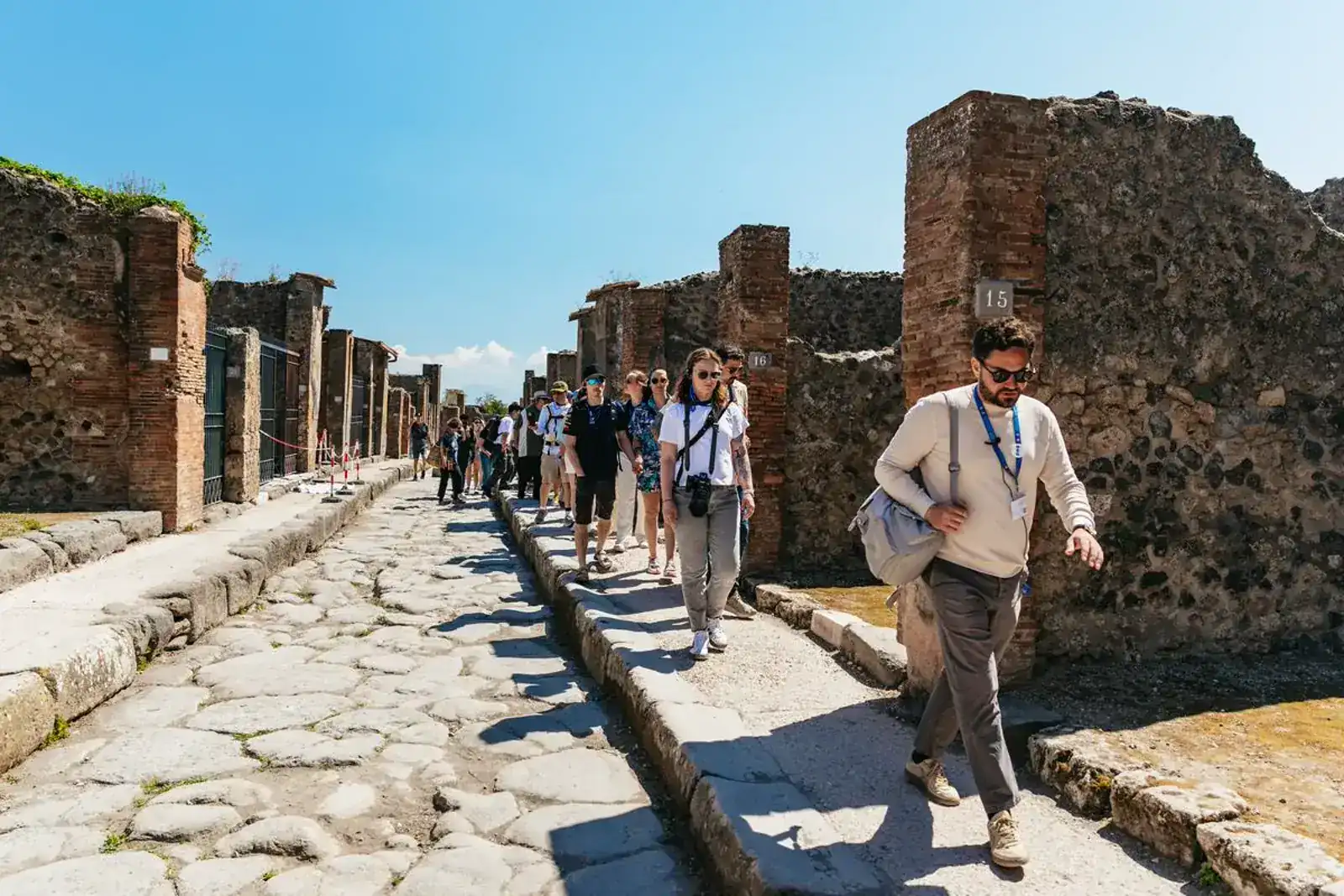
For February 2027, the park's currently published winter timetable is 9:00 AM to 5:00 PM, with last entry at 3:30 PM. The regular adult tickets are €20 for Pompeii Express and €25 for Pompeii Plus, on the tariff introduced on 12 January 2026. Choose a morning with a reasonable forecast, wear shoes with reliable grip and leave enough time to explore without racing the clock.
The trade-off is the weather. February around Naples can be chilly, windy and wet, and most of Pompeii is open to the sky: it is not an indoor museum where you can wait out a downpour. These details were checked on 4 November 2026 and may change before your trip, so confirm dates, prices and special notices on the official Pompeii timetable and tickets page.
This guide covers what February feels like, how busy the ruins tend to be, which ticket and tour to choose, how to get there from Naples or Sorrento, and what to do if the forecast turns wet.
| Question | Quick answer |
|---|---|
| Is Pompeii open in February? | Yes, on ordinary days. The park's standard closure dates are Christmas Day and New Year's Day, not February. Unexpected closures can still happen. |
| February opening hours | 9:00 AM–5:00 PM |
| Last general admission | 3:30 PM |
| Best time to arrive | 9:00–10:00 AM |
| How long to allow | 3–4 hours for a first visit; about 2 hours for the highlights only |
| Typical daytime temperature | Roughly 12–14 °C (54–57 °F), on Naples-area long-term averages |
| Rainfall | Rain stays a realistic possibility, sometimes heavy; the forecast matters more than the monthly average |
| Crowds | Usually lighter than in peak season; the free Sunday, weekends and holidays can be busier |
| Standard adult ticket | €20 Pompeii Express, on the currently published tariff |
| Expanded adult ticket | €25 Pompeii Plus, if you want the suburban villas |
| February 2027 free Sunday | Sunday 7 February, if the park confirms its usual program |
| Best guided-tour format | About 2 hours in the morning, then time on your own |
| Main winter limitation | Some houses stop admitting visitors at 4:00 PM, before the park's 5:00 PM closing |
Our recommendation: for a first visit, take an early train from Naples or Sorrento, start at Porta Marina or Piazza Esedra, spend the morning with a guide or on a planned walking route, and keep the afternoon flexible. If the forecast is poor and you have several days in the area, move Pompeii to the driest one.
Comparing other months? Our complete Pompeii winter guide sets December, January and February side by side, and Pompeii in January covers the month before.
For many travelers February is one of the best compromises of the winter season. You are more likely to move through Pompeii's narrow streets without big clusters of visitors, and you can usually explore at a comfortable pace. The Forum, the theaters, the public baths and the beautifully decorated houses can look especially atmospheric in the low winter light.
Part of the reason is the scale of the place. Pompeii was a working Roman town. Its excavated streets run between houses, bakeries, shops, temples, public squares and places of entertainment, and understanding how they connect takes walking and time. A day in the low teens Celsius is easier for that than a hot summer afternoon.
February also has an advantage over midwinter: the days lengthen noticeably. In Pompei, daylight grows from about 10 hours 10 minutes on 1 February 2027 to roughly 11 hours 15 minutes by 28 February, and by late February the sun sets at around 5:45 PM. The park still closes at 5:00 PM all month, but the longer light helps before opening and on the journey back.
Bottom line: February is good for archaeology and walking, not for a guaranteed sunny Mediterranean break.
A February trip to Pompeii usually sits inside a few late-winter days around the bay: the National Archaeological Museum and old center of Naples for a wet afternoon, the compact excavations at Herculaneum, a Mount Vesuvius crater walk if the summit is clear, and a quiet base in Sorrento with the Amalfi Coast beyond it. These tours and tickets around Pompeii run in winter.
The official winter timetable runs from 15 October to 15 March, so all of February falls inside it.
| What | Published winter hours |
|---|---|
| Park opens | 9:00 AM |
| Last general entry | 3:30 PM |
| Park closes | 5:00 PM |
| Many well-known houses open | Commonly around 9:15 AM |
| Last entry to many houses | Commonly 4:00 PM |
| Many houses close | Commonly 4:20 PM |
| Last access to the Porta Ercolano suburban-villas route | 3:30 PM |
Don't confuse last entry with a sensible arrival time. Getting through the gate at 3:30 PM does not mean you can see the main sights in the remaining 90 minutes. Pompeii is too big, and several of its best interiors have earlier cutoffs of their own.
The park's current list gives the House of the Vettii, the House of Menander, the Lupanar, the Stabian Baths, the Forum Baths and the Antiquarium last admission at around 4:00 PM and closing at around 4:20 PM. Individual buildings can also close for a while for archaeological work, conservation, access restrictions or staffing.
For the Villa of the Mysteries the timing matters even more. The villa lies outside the central city, and access through Porta Ercolano to the suburban-villas route stops at 3:30 PM in winter. Allow time to walk there and see the villa properly, and don't leave it to your final hour.
The park's opening-times page and its list of buildings currently open carry the authoritative updates. Our winter opening-hours guide explains the difference between the main park and individual house hours.
The main archaeological park has no routine closure in February and no regular weekly closing day under the published schedule. Extraordinary weather, conservation work and special operating notices can still affect access.
A guided tour can also be cancelled or changed on a February date without the park itself closing. Check the tour operator's meeting time and cancellation conditions separately from the entrance timetable.
Sunday 7 February 2027 is the first Sunday of the month. Pompeii normally takes part in Italy's Domenica al Museo scheme, which gives free entry to state cultural sites on the first Sunday of each month. The park currently lists direct access for free-entry days, but reconfirm the arrangements closer to your travel date.
Free admission is attractive on a budget, but it can also make the day busier than a typical February weekday. Admission is free; transport, private guides, audio-guide rental and any service that charges separately are not.
If you are choosing between the free Sunday and an ordinary Tuesday or Wednesday, start from what matters most to you:
| Your priority | Better choice |
|---|---|
| Lowest possible admission cost | Sunday 7 February, if the standard program runs |
| A quieter walk and easier access to popular interiors | An ordinary weekday morning |
| A specific paid guided tour | A date the tour operator confirms as available |
| The best weather | Whichever date has the driest forecast |
Carnival falls in early February in 2027: with Easter on 28 March, the last Carnival weekend is 6–7 February, the same weekend as the free Sunday, and Shrove Tuesday is 9 February. Several towns in Campania hold parades and events around those dates. Carnival is no reason to expect Pompeii to close, but transport, hotel demand and local day-trip patterns can be different on festival weekends, so check event plans if you are combining the ruins with an Amalfi Coast stay.
Valentine's Day, 14 February 2027, falls on a Sunday. It is not a park closure under the published winter schedule, and an ordinary Sunday a week after the free one is usually calmer.
February is one of the cooler months on the Bay of Naples. Typical daytime highs are in the low teens Celsius, about 12–14 °C (54–57 °F), with a long-term average high of 13.5 °C (56 °F) and about 9 rainy days in the month. Mornings and evenings often feel much colder, and rain is common enough that you should plan for it.
These are regional climate averages for the Naples area. Different sources measure over different periods, so the exact averages vary. The practical picture is consistent: mild compared with a northern European winter, but not warm, and possibly wet.
| Weather factor | What to expect in February |
|---|---|
| Daytime temperature | Around 12–14 °C (54–57 °F) on average |
| Early mornings | Often around 5–8 °C (41–46 °F), sometimes colder |
| Rain | A real possibility throughout the month; some days can be very wet |
| Wind | Can make the Forum and the exposed streets feel distinctly chilly |
| Daylight | About 10 hours 10 minutes at the start of February, rising to around 11 hours 15 minutes by the end |
| Snow at the ruins | Unusual |
| Snow on Mount Vesuvius | Possible at times, and striking when you can see it above Pompeii |
A bright day at 13 °C is pleasant for several hours of walking. The same temperature with wind and steady rain feels far less comfortable, especially when you stand still for 15 minutes while your guide explains a site.
On average February edges slowly toward spring, but the weather can vary more from one day to the next than between the start and the end of the month. A sunny first week can be more comfortable than a rainy last week, and the reverse is just as possible.
The dependable late-February advantage is daylight. The sun sets noticeably later, which gives you more light for the trip back to Naples or Sorrento, even though Pompeii still closes at 5:00 PM.
Aim for clothes warm enough for slow outdoor sightseeing and practical enough for uneven ancient streets:
An umbrella helps in light rain, but a hood is easier in the wind. Don't bring a large suitcase to the entrance: the park does not allow bags larger than 30 × 30 × 15 cm inside, and luggage storage at Porta Marina and Piazza Anfiteatro is paid; the official visitor services page has the details.
For a fuller wet-weather plan, read Pompeii in the rain.
February is part of Pompeii's low season. The park's own figures for 2024 show about 4,900 visitors a day in February, a little busier than January's 3,600 but well under May's 16,700. It is usually easier to walk around the Forum and the residential streets than on a busy spring or summer day, but the site is not empty, and the popular houses are not always free of a wait.
Crowds vary with the weather, tour-group schedules, weekends and regional holiday travel. In February 2027, keep the free-entry Sunday on 7 February in mind. Mid-February school holidays differ by country and school system, so visiting families can add some demand, but don't count on a surge.
Generally yes. Visitor numbers climb as the weather improves toward the main European travel season. Still, a dry February Saturday can draw plenty of people and a wet spring weekday can be quiet. "Low season" is a useful planning clue, but nobody gets the archaeological site to themselves.
The park sells several ticket types. For most February day trips the choice comes down to Pompeii Express or Pompeii Plus.
| Ticket type | Published adult price | What it covers | Who should choose it |
|---|---|---|---|
| Pompeii Express | €20 | The main ancient city; not the suburban villas | Most first-time visitors spending 2–4 hours |
| Pompeii Plus | €25 | The main city plus the suburban villas, including the Villa of the Mysteries and the Villa of Diomedes, Villa Regina at Boscoreale and the shuttle bus | Visitors who specifically plan to see the suburban villas |
| Grande Pompei, 3-day ticket | €30 | The wider Greater Pompeii network over three days, on its published terms | Archaeology enthusiasts visiting several sites |
| The park's thematic guided tour | €8 plus an entrance ticket | About 90 minutes on a scheduled civic-life or daily-life theme | Budget visitors who want some interpretation |
These are the prices published for tickets from 12 January 2026, and they could change before February 2027. Check the current ticket page before you pay.
Choose Express if you plan to spend three or four hours on Pompeii's central streets, the Forum, the theaters, the public baths and a few houses. It is the simplest first-time ticket. If you change your mind on the day, the park lets you upgrade Express to the suburban-villas route at the Herculaneum Gate (Porta Ercolano) for €8, card payment only, so €28 in all.
Choose Plus if the frescoes of the Villa of the Mysteries are a main reason for your visit and you can give the outlying route the time it needs. February daylight and the 3:30 PM last access make an early start essential.
A standard ticket does not let you leave and come back in on the same admission. If you want lunch outside the park, have it before you go in or after you finish.
Pompeii tickets are personal under the current rules, so bring the identification that matches your booking. The park's website links to its official online ticket seller, and its published information lists ticket offices at Porta Marina, Piazza Esedra and Piazza Anfiteatro.
Our Pompeii tickets explained guide covers reductions, booking practicalities and how tickets compare with guided-tour packages.
The main value of a guided package in February is the guide and the convenience; the queues are rarely long. Even in low season you still go through the entry and security procedures, and a third-party ticket does not let you skip every line.
Compare the total cost, what is included (entrance ticket or guide only), the actual meeting point and the cancellation policy before you choose a reseller. A cheaper-looking tour can cost more once you add the entrance it leaves out.
A good guide changes how you see the archaeological city. Without context a doorway is just a doorway; with a knowledgeable explanation it becomes part of a Roman house, a bakery, a bath complex or a shopping street. Which format suits you depends more on how you travel and how much time you have than on February itself.
| Visitor type | Recommended experience | Why it works in February |
|---|---|---|
| First-time visitor | 2-hour small-group tour with an archaeologist | Covers the main highlights in the brightest part of the day |
| Budget traveler | The park's thematic tour, about 90 minutes (€8 + entry) | A low-cost guided explanation with time left to explore |
| Independent history enthusiast | A self-guided route plus the official map | The most flexibility when the weather changes |
| Family with children | A private or family-focused guide, 1.5–2.5 hours | Easier to adapt the stops, pace and explanations |
| Traveler with limited time | A highlights tour with admission included | You don't spend your short winter day working out the site |
| Visitor focused on frescoes | A longer tour including the Villa of the Mysteries | Better interpretation, but it needs the right ticket and an early start |
| Visitor leaving from Naples | A Pompeii tour with transport, or the train plus a tour that meets at the ruins | A choice between convenience and independent flexibility |
A morning tour of about two hours is a strong default. You see the Forum, a few significant houses, a bath complex and other highlights, with explanations that connect the ruins to ordinary Roman life.
Before you book, check:
Don't read live February 2027 availability into an evergreen tour description; check the booking calendar. Our guide to Pompeii winter guided tours compares the options.
The Express ticket is part of the price, so the $34 covers both the archaeologist and your entry, with groups capped at 20. Book a 9:00 or 10:00 AM start and you finish the guided walk around midday, with the afternoon light left for the Vettii and the other houses that stop letting people in at 4:00 PM.
Check February datesFree cancellation up to 24 hours before · secure checkout via GetYourGuide
A private guide usually costs much more for one or two people, but the sums change for a family or a group splitting one price. It also makes sense if you want to concentrate on art, archaeology or domestic life instead of following a fixed highlights route. The 2-hour private tour with an archaeologist guide is priced per group of up to five, from about $260 (€225), with the Express entry depending on the option you pick, and holds 4.9/5 from more than 850 reviews.
Private does not mean every excavated house will be open to you. Guides still follow the park's access rules and any temporary closures.
Since March 2026 the park has run thematic tours of about 90 minutes on Civic Pompeii or Daily Pompeii, at €8 per person on top of admission. Children under 10 go free on the tour. The routes start from different entrances, so check the meeting point when you book. If you arrive independently, it is a good alternative to a full commercial package. The details are on the official independent visitors and thematic tours page; check that there is a place on your February date.
You don't need a guide to explore Pompeii. A self-guided visit suits February because you can linger in a sheltered spot during a passing shower or cut the route short if the weather turns.
Download the official excavation map before you arrive. Mind the park's rules on audio guides: only authorized providers' devices may be used inside. A downloaded map and your own notes are fine; an unauthorized audio-guide device is not. Our Pompeii self-guided walking tour gives you a focused route through the Forum, selected houses and the theater district.
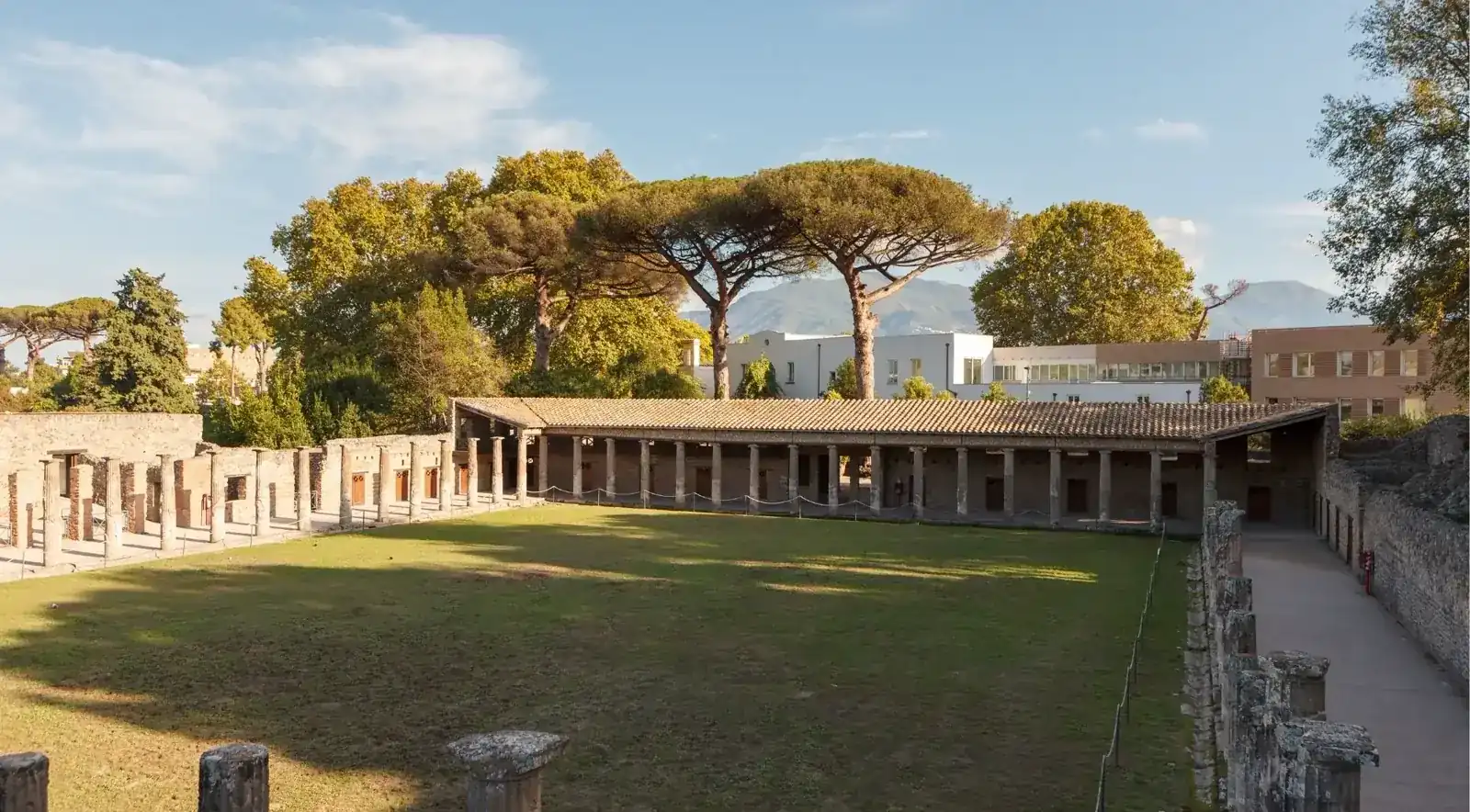
A realistic first visit focuses on a manageable part of the city. February is not the month to list every house and then sprint from one end of the park to the other.
Here is a suggested 3–4-hour route, starting around 9:30 AM at Porta Marina. The order is flexible and depends on which houses are open on the day; follow the signs and the official paths.
| Stop | Approximate time | Why it matters |
|---|---|---|
| 1. Porta Marina and the approach to the Forum | 10–15 min | Get a sense of Pompeii's layout |
| 2. The Forum and the Temple of Jupiter | 25–30 min | The civic and ceremonial center, with views toward Vesuvius |
| 3. The Sanctuary of Apollo and the Basilica | 20 min | Public life, religion and architecture |
| 4. The House of the Faun area | 20–25 min | Grand domestic architecture; interior access as posted |
| 5. The House of the Vettii, if open | 25–30 min | Famous decorated rooms and a look at domestic status |
| 6. The Lupanar and the streets around it | 15–20 min | A small but much-discussed part of the ancient city |
| 7. The Stabian Baths | 20–25 min | How a Roman bathing complex worked |
| 8. Via dell'Abbondanza and a food-shop front | 20 min | Everyday street life and trade |
| 9. The Large Theatre and the theater district | 25–30 min | A different side of public entertainment |
| 10. The Antiquarium or a last nearby highlight | 20–30 min | Useful context, depending on opening and where you finish |
Add time for walking, breaks, signs, queues at the most popular interiors and unexpected closures. These are rough stop times for planning. On the day, go by the official map and the current open-buildings list.
If the forecast looks uncertain or you have limited stamina, keep to the Forum, one important house, the Stabian Baths or the Lupanar, and the theater district. You still get the city's basic shape without trying to see everything.
With a dry morning, an early arrival and the Pompeii Plus ticket, you can add the Villa of the Mysteries. Plan that extension before the last access time at Porta Ercolano. If the villa is a major reason for your visit, start with the suburban route or put it near the top of the day. Our House of the Vettii guide covers one of the most memorable interiors on the way.
Best for: first-time visitors staying in Naples, independent travelers and couples.
| Time | Plan |
|---|---|
| 8:00–9:00 AM | Take a morning train toward Pompeii, allowing for your actual departure station and service |
| 9:15–9:45 AM | Arrive at Pompei Scavi–Villa dei Misteri and walk to the Porta Marina area |
| 9:30–11:30 AM | A guided highlights tour, or a self-guided Forum and houses route |
| 11:30 AM–12:30 PM | Explore one more area on your own |
| 12:30–1:30 PM | Finish the visit; lunch after you leave or at an authorized refreshment point |
| Afternoon | Back to Naples, or another sight if transport and opening times allow |
Allow more time if your train runs late or your guide meets at another entrance. These timings show a sensible day; they are not a live train schedule or a confirmation of tour availability.
Best for: visitors with a particular interest in Roman painting, or who want more than the central ruins.
Start at opening, spend two to three hours in the ancient city, take a break at an authorized refreshment point, then go on to the Villa of the Mysteries while the suburban route is still open. Don't leave the villa until 3:30 PM or later; that is already the published last access time for the route. The 3-hour Villa of Mysteries tour with an archaeologist (4.8/5 from more than 1,400 reviews, from $58) builds the villa into a guided morning.
Expect a lot of walking. If you are going back to Naples or Sorrento after 4:00 PM, check the train services and any weather alerts in advance.
Best for: visitors with only one free day, or a forecast showing passing showers.
Put the Forum and one or two open interiors first, in the morning. Keep the route compact and flexible, allow 2–3 hours instead of five, and have an indoor afternoon ready in Naples. The National Archaeological Museum of Naples is the natural companion, since many of Pompeii's finest finds are there, but check its galleries and opening calendar separately.
A light shower will not close Pompeii. Equally, don't stay out in dangerous weather because your tour is already paid for. Follow park staff instructions and any official closures.
February does not change the geography, but the shorter opening hours make early departures and realistic connections more important.
From Naples, the Circumvesuviana Naples–Sorrento line stops at Pompei Scavi–Villa dei Misteri, close to Porta Marina. It is usually the most direct rail route for a first-time visitor heading to the western entrance. The ride commonly takes 35–45 minutes from the main Naples stops, but use the published timetable for your date.
Naples also suits a wet February because the city has museums, restaurants and other indoor sights, so you can choose your Pompeii day by the weather instead of committing every day to a distant coastal trip. Read our Pompeii from Naples guide and the Naples to Pompeii winter transport guide. If you would rather not deal with the train, the Pompeii tour from Naples with ticket, guide and transfer (4.7/5 from more than 2,950 reviews, from $53) handles the travel.
Sorrento sits at the other end of the Circumvesuviana line, with Pompei Scavi–Villa dei Misteri as an intermediate stop, so it is an easy base if you are already on the Sorrento peninsula. Allow roughly 30–45 minutes on the train, depending on the service, plus time to reach the entrance.
Sorrento can be quieter in February, and some seasonal sights, hotel services and ferries run less often than in summer. If you are going mainly for Pompeii, compare staying in Naples or modern Pompei too. See Pompeii from Sorrento and the Amalfi Coast in winter, and our where to stay for Pompeii guide compares the bases.
A February day trip from Rome works if you leave early. The usual route is a fast train to Naples, then a local connection or a transfer to the ruins. A packaged day tour simplifies the logistics, but it cannot change Pompeii's 5:00 PM closing.
If you want a relaxed five-hour visit, a night in Naples beats a long same-day return. If you must go from Rome, check what the ticket includes and whether a Vesuvius or Amalfi add-on leaves you enough time at Pompeii. See Pompeii tours from Rome.
Several stations have similar names, and they do not all bring you to the same entrance:
The park's official getting-here page explains the main connections. Always match the station, the tour meeting point and the entrance name on your booking.
Before you leave your hotel, check:
Sometimes, yes, but February is a month when flexibility matters most. The two run independently: Pompeii is an archaeological park near sea level, while the Vesuvius crater walk is much higher, colder and more exposed to wind or snow.
Vesuvius National Park currently lists 9:00 AM–3:00 PM as the access window for its Gran Cono crater path in January and February, with the visit ending within an hour of the last entry. Crater tickets are sold online, and access can be suspended for bad weather or safety reasons. These rules can change.
An all-in-one excursion helps if you are short of time, but check the operator's weather plan and refund policy. In February, don't book a Vesuvius hike only because the forecast for central Naples looks good: conditions on the volcano can be very different. The full-day Pompeii and Mount Vesuvius tour from Naples or Sorrento (4.6/5 from more than 5,000 reviews, from $107) does the driving, but its crater stop still depends on the weather.
For a first-time visitor with only one February day, we would make Pompeii the priority and add Vesuvius only if the weather, the crater notice, the transport and the timing all line up. A second day gives you far more room. Read Pompeii and Vesuvius in winter and Mount Vesuvius tours and tickets.
If you are choosing between the two, the basic difference is scale and character.
Pompeii is the larger ancient city. It is better for grasping the scale of Roman urban life, from streets and houses to the Forum, the baths, the theaters and the amphitheater, and a satisfying first visit usually takes three or four hours.
Herculaneum is more compact, with exceptionally well-preserved buildings and details. It is a sensible alternative when you have less time, but it is still an outdoor site and February rain falls there too.
For an archaeology-focused trip, seeing both over two days is ideal. One day for both works with an early start, but the transport and winter hours need careful planning, or a guide who has done it: the Pompeii and Herculaneum tour with an archaeologist (5.0/5 from more than 300 reviews, from $127) covers both in five hours. See Pompeii vs Herculaneum in winter.
A little rain need not ruin the day; persistent heavy rain is another matter. The park is mostly open-air roads and squares paved with irregular stone, and storms can make conditions unsafe or close areas for a while.
If the rain is light or on and off: wear a waterproof jacket and non-slip shoes, keep the route compact, and follow park staff and your tour leader. A short guided tour can still be enjoyable.
If heavy rain is forecast: move your visit to a drier day if your schedule allows. If not, shorten the route and make a Naples museum or another indoor sight the center of your afternoon.
If the park closes unexpectedly: check the park's official notice and the terms of your ticket or tour. Not every cancellation is treated the same way. The park's personal-ticket rules are strict, although they make an exception when the park itself closes for extraordinary reasons.
For a practical checklist, read Pompeii in the rain: what to do and what to avoid.
Last entry is 3:30 PM, but the best time to start is the morning.
Most of your visit is outside, so plan for wind and showers.
Many interiors stop admitting visitors at around 4:00 PM.
Check which ticket covers the suburban villas before you pay.
The local and national railway stations serve different parts of town.
Snow or wind on the crater is separate from the weather at Pompeii.
Compare admission, guiding, group size and cancellation terms, not the marketing phrase.
7 February 2027 may draw more visitors than an ordinary weekday.
The park restricts bag sizes and offers paid storage only at certain entrances.
Timetable changes and station mix-ups can still spoil a tightly scheduled tour.
Yes, on ordinary days. The park's published winter timetable is 9:00 AM–5:00 PM. There is no general February closure in the standing schedule, but temporary operational or weather-related changes are possible.
5:00 PM, with last general admission at 3:30 PM. Some interiors stop admitting visitors at around 4:00 PM and close before 5:00 PM.
Yes, if you prefer lighter crowds and cooler weather. It suits you less if you want dependable sunshine and dry walking conditions. An early visit on a reasonably dry day is the safest plan.
It can feel cold, especially on cloudy or windy mornings. Long-term Naples-area averages put daytime highs at around 12–14 °C, but lower temperatures are possible and the exposed ruins can feel chillier than a sheltered city street.
Rain is still a real winter possibility, with about 9 rainy days in an average February around Naples. Some February days are bright and dry; others are wet. Use a short-range hourly forecast for your travel dates, not only the monthly averages.
Snow in the excavated city is unusual. Snow on the higher slopes of Mount Vesuvius is more likely and can sometimes be seen from the ruins.
Usually less crowded than spring and summer, though weekends, the free-entry Sunday and visiting groups can still create busy periods around the most famous houses.
7 February 2027 is the month's first Sunday, when the park's usual free-entry scheme is expected to apply. Confirm the entry arrangements for that day on the official park website nearer the date.
Valentine's Day, Sunday 14 February 2027, is not listed as a routine park closure under the published winter schedule. Check for any special event or operating notice before setting out.
Most first-time visitors should allow 3–4 hours. Two hours can work for the highlights only. Allow 5 hours or more for a slower archaeological visit or a day that includes the Villa of the Mysteries.
January can be especially quiet, but February has longer days, particularly near the end of the month. Both have the same published winter park hours and similar weather uncertainty. If your trip spans both months, choose the better forecast.
February usually feels more firmly low season. March often brings milder conditions and longer daylight, but the park's longer seasonal opening hours do not begin until 16 March. Neither month guarantees dry weather.
Absolutely. Use the official map, arrive early and choose a manageable route. A guide is an optional upgrade for historical context, not a requirement to enter.
Many operators advertise year-round tours, and the park runs its own themed guided visits. Availability for a specific February 2027 date is not guaranteed until the booking calendar or the provider confirms it.
Yes. The Circumvesuviana Naples–Sorrento line serves Pompei Scavi–Villa dei Misteri, close to the Porta Marina entrance. Check the current EAV timetable and leave enough buffer before a guided-tour meeting time.
It is possible in suitable conditions, but the Vesuvius crater has short winter access hours and weather-related restrictions, and a combined day can feel rushed. Put Pompeii first if the weather or your time is uncertain.
Yes, particularly for children interested in volcanoes or ancient history. Plan shorter routes, warm layers and breaks. Families with toddlers should check the park's accessible route, the baby-changing points and the uneven surfaces. Our Pompeii with kids guide has a family route.
It can be for a family, a small group or anyone with specialist interests. For most solo travelers and couples, a small-group archaeologist-led tour is the more economical choice. Always compare the total cost including entrance.
Yes, if you are happy to plan around the weather. February gives you cooler walking conditions, generally lighter crowds and noticeably more daylight than the depth of winter. In return you accept the chance of rain and the 5:00 PM winter closing.
For most first-time visitors the plan is simple: arrive by 9:30 or 10:00 AM, allow three to four hours, see the Forum and a short list of houses, and finish before the afternoon turns into a race. Book a small-group guide if you want the city explained; go on your own if flexibility matters more.
Based in Naples, you can pick the driest day, which makes February especially practical. If Vesuvius is on your list too, treat it as a weather-dependent extra, not a guaranteed add-on.
Plan your visit: compare winter Pompeii tours, check Pompeii tickets and read our winter opening-hours guide.
Researched on 4 November 2026 for February 2027. Opening hours, ticket prices, free-entry procedures, individual buildings, tour availability and train timetables can change before you travel.