- Porta MarinaBest entrance for this route
- 3–4 hrsMain route, plus breaks
- €20Pompeii Express adult entry
- 3:30 PMLast entry, 15 Oct–15 Mar
- No re-entryOne entry per ticket
Pompeii Without a Guide: Porta Marina to Piazza Esedra in 3–4 Hours
For a first visit, allow three to four hours to walk from Porta Marina through the Forum, the famous houses, the baths and the theatre district, and finish at Piazza Esedra. You get a varied picture of everyday Roman life without trying to cover every excavation. With more time, add the amphitheatre in the east or the Villa of the Mysteries to the northwest. If you would like an expert for the first part, the Pompeii entry ticket and guided tour with an archaeologist covers the centre in two hours and leaves you free to walk the rest of this route alone.
Quick plan: enter at Porta Marina → Forum and Temple of Apollo → Basilica → Forum Baths → House of the Faun → House of the Vettii → Lupanar → Stabian Baths → Via dell'Abbondanza → House of Menander (if open) → Large Theatre → leave at Piazza Esedra. Allow three to four hours, plus breaks. Opening arrangements for individual buildings can change.
Pompeii Self-Guided Tour at a Glance
| Planning question | Our answer |
|---|---|
| Best entrance for this route | Porta Marina, near Pompei Scavi–Villa dei Misteri railway station |
| Best exit | Piazza Esedra, close to Porta Marina, not the far eastern gate |
| Time needed | 3–4 hours for the main route; 4–5 hours with longer breaks and extra interiors |
| Standard adult entry | €20 for Pompeii Express, the price the park lists from 12 January 2026 |
| Which ticket? | Pompeii Express for the main ancient city; Pompeii+ if you are adding the suburban villas |
| Must-see stops | Forum, House of the Faun, House of the Vettii, Lupanar, Stabian Baths and Large Theatre |
| Best start time | Soon after the 9:00 AM opening, especially in winter |
| Need a guide? | No, but the park's official audio guide or a licensed guided tour adds the history |
Pompeii doesn't have a marked trail. The stops below are the order we'd walk them in, chosen so that the Forum explains the city before you reach the houses, and so that you finish on the western side, close to the station you probably arrived at.
Other Experiences You Might Enjoy
If you are exploring Pompeii on your own, the same trip can include the crater of Mount Vesuvius, the smaller and better-preserved Herculaneum, the National Archaeological Museum of Naples, home of the Alexander Mosaic (off display while it is restored), or a day on the Amalfi Coast and in Sorrento. These are tours and tickets around Pompeii and the bay.
Download the Official Pompeii Map
Start with the park's own map, not a generic city map. Modern Pompei and the archaeological park are different places, and some ancient streets or individual houses may be closed for conservation.
- The official Pompeii archaeological site map (PDF) shows the ancient streets, the regions, the key buildings, the entrances and the facilities.
- The official map and excavation guide page also has the park's longer visitor guide.
- The list of houses and buildings currently open is the page to check if your day depends on the House of the Vettii or the House of Menander.
How to use the route: keep the official map on your phone or print it. The numbered stops below are a recommended route, not a signposted trail. If a street is closed on the day, follow the signs and the staff's directions.
Pompeii Walking Route: 11 Stops in a Logical Order
Stop 1. Porta Marina: enter the ancient city
Allow 5–10 minutes
Porta Marina was one of the gates in Pompeii's city walls. Coming in this way puts you among Roman streets straight away and close to the main civic centre. It is the easy choice if you arrive on the Circumvesuviana Naples–Sorrento line and get off at Pompei Scavi–Villa dei Misteri.
Before heading deeper into the excavations, find the nearest toilets, download your map and check you have water. The ancient basalt paving is uneven, so expect slopes, raised kerbs and steps even on short stretches.
Stop 2. The Sanctuary of Apollo and the Forum
Allow 20–30 minutes
The Forum was Pompeii's civic and commercial heart, a broad open square framed by religious, administrative and commercial buildings. The ruins of the Temple of Jupiter stand at its northern end, with Mount Vesuvius behind them on a clear day.
On the Forum's western side, the Sanctuary of Apollo shows another side of the city's religious life. Take in the columns, the temple platforms and the way the square is laid out before you start hunting for photographs.
This is where Pompeii's layout starts to make sense: you can see how a Roman city arranged worship, public life, trade and civic authority around a shared centre.
Stop 3. The Basilica: Pompeii's public business centre
Allow 10–15 minutes
Walk to the Forum's southwestern side for the Basilica. Despite the name, it was not a Christian church. In Roman Pompeii it was a major public building used for legal and commercial business.
Its scale and the columns that remain show an ambitious city, much more than the collection of villas many visitors picture. It also makes a useful contrast with the narrow residential streets you will walk later.
Stop 4. The Forum Baths: how Romans relaxed
Allow 10–15 minutes, if open
Head north of the Forum to the Forum Baths, where you can see how public bathing fitted into everyday city life. Look for the sequence of rooms kept at different temperatures, the niches and the decorative details.
Not every part of the baths is always open. If the building is closed or busy, carry on with the route instead of waiting: the Stabian Baths come later.
Stop 5. The House of the Faun: luxury on a Roman scale
Allow 15–20 minutes
Continue into Regio VI for the House of the Faun, one of Pompeii's most celebrated private homes. Its large courtyards and elaborate layout show how wealthy its owners were.
The house is known for its dancing-faun statue and the Alexander Mosaic. The original Alexander Mosaic is in the National Archaeological Museum in Naples, so don't expect to see the masterpiece itself in its ancient setting. It is currently off display for restoration; our Pompeii and Naples Archaeological Museum guide has the latest on the museum's galleries.
Look for the way the entrance, the atriums, the gardens and the reception rooms connect. The arrangement says as much about Roman status and hospitality as the decoration that survives.
Stop 6. The House of the Vettii: colourful frescoes and family life
Allow 15–25 minutes, if open
The nearby House of the Vettii is one of the best reasons to go beyond the central square. Its richly painted rooms help you understand Roman painting, mythology and the social ambitions of a prosperous household.
It can be one of the most rewarding interiors on the whole site, but its hours and visitor numbers are controlled. In winter some houses close their interiors earlier than the park itself. Check the official list of open buildings before making this stop the centrepiece of your day. Our House of the Vettii guide covers the house's history and paintings.
Stop 7. The Lupanar: a different side of Pompeii
Allow 10–15 minutes, if open
Head back towards the central streets and the Lupanar, Pompeii's best-known purpose-built brothel. Its small rooms, stone beds and surviving wall paintings show another part of city life.
The interior is tiny and can have a queue even on quiet days. It also contains sexually explicit images, so families may prefer to skip it or decide in advance how to handle it with children.
If it is closed or crowded, spend the time on the streets around it instead, looking at the shopfronts and the traces of Roman trade.
Stop 8. The Stabian Baths: one of Pompeii's great public buildings
Allow 15–20 minutes, if open
Continue towards Via Stabiana and the Stabian Baths, a large bathing complex. They are especially good for understanding ancient engineering and the daily routines of Roman social life.
The rooms and courtyards that survive make a Roman bath much easier to picture than any written description. Which rooms are open can change with maintenance or staffing.
Stop 9. Via dell'Abbondanza: walk through everyday Pompeii
Allow 15–25 minutes, including detours
Now give some time to Via dell'Abbondanza, one of Pompeii's main streets. The street itself is one of the sights.
Notice the deep ruts left by cart wheels, the raised stepping stones, the shop entrances and the traces of trade. Many businesses opened straight onto the street. Look for the counters of the thermopolia, where hot food and drinks were served.
Few places on the site give you a stronger sense of Pompeii as a working town instead of an open-air museum.
Stop 10. The House of Menander: an optional interior
Allow 10–20 minutes, if open
If the House of Menander is open to visitors, make a short detour into this important house in Regio I. Its courtyards and decoration make a good comparison with the more famous houses farther north.
Treat it as an optional stop, not one to plan the whole walk around. If it is closed, save the time for the theatres.
Stop 11. The Large Theatre and the theatre district
Allow 20–30 minutes
Finish in the theatre district, where the Large Theatre and the buildings around it show how much public entertainment mattered. The big seating bowl still gives you a feel for the crowds a performance could draw.
You can also see the Quadriporticus, a colonnaded courtyard linked to the theatres and later used as the gladiators' barracks. The Small Theatre (Odeion) may be visible only from outside, depending on current arrangements.
From here, follow the park signs to the Piazza Esedra exit. It is a convenient finish if you are heading back to Pompei Scavi–Villa dei Misteri station or other transport on the western side.
Have Only Two Hours? Use This Shorter Pompeii Route
With just two hours inside the park, don't try to reach the amphitheatre and every famous villa. Keep to a compact loop:
- Enter at Porta Marina.
- Explore the Sanctuary of Apollo and the Forum.
- Visit the Basilica.
- Continue to the Forum Baths if they are open.
- Choose one major house: the House of the Faun or the House of the Vettii.
- Head towards the Lupanar and the Stabian Baths, depending on time and access.
- Return towards Piazza Esedra or Porta Marina, following the park's current exit signs.
That gives you the public centre, a grand house and a taste of everyday street life. Two hours is enough for an introduction, not a complete visit.
If that sounds too rushed, a short tour can be a quicker way to understand what you are looking at: the two-hour Pompeii tour with an archaeologist and entry ticket covers much the same ground. Our Pompeii guided tours guide compares the options, and our Pompeii winter itinerary sets out timed 2-, 3- and 5-hour routes for a short winter day.
Have Five or Six Hours? Add the Amphitheatre
For a longer day, carry on east from the central districts along Via dell'Abbondanza instead of turning southwest towards Piazza Esedra. Add:
- the Garden of the Fugitives, where the human cost of the eruption comes close, if it is open;
- the Large Palaestra, where the park currently lists an exhibition of casts and organic finds (check that it is open);
- the Amphitheatre, one of Pompeii's most impressive entertainment buildings.
Finish at Piazza Anfiteatro, the eastern entrance and exit, instead of walking all the way back to Porta Marina. Allow roughly 1½ to 2 extra hours, depending on which interiors are open, the crowds and your breaks.
Check your onward transport first. Piazza Anfiteatro is not beside Pompei Scavi station the way Porta Marina is; the nearest Circumvesuviana stop on that side is Pompei Santuario, on a different line. Check your train or transfer before you choose this one-way extension.
Want the Villa of the Mysteries? You Need a Different Ticket
The Villa of the Mysteries is famous for its painted room, but it stands outside the city walls to the northwest. It is not a quick five-minute addition to the central route.
To add it, allow at least 60 to 90 extra minutes for the walk and the visit, and buy the right ticket:
| Ticket | Adult price | Does it suit this route? |
|---|---|---|
| Pompeii Express | €20 | Yes: covers the main route and the amphitheatre, but not the suburban villas. |
| Pompeii+ | €25 | Yes: adds the Villa of the Mysteries, the Villa of Diomedes and the other sites and services it includes. |
| Three-day combined ticket | €30 | Better if you are also visiting other archaeological sites such as Oplontis or Stabiae. |
The park also lists an €8 suburban-villas upgrade for Express ticket holders, sold by card only at the Herculaneum Gate (Porta Ercolano), where the villa route starts. A €25 Pompeii+ ticket costs less than Express plus the upgrade, so buy Pompeii+ from the start if the villa is definitely on your list.
In winter, go early. The park lists 3:30 PM as the last entry to the suburban-villas route at Porta Ercolano in the winter season, so visit the villa earlier in the day, not just before closing.
If you'd like someone to explain the paintings, the three-hour Villa of the Mysteries tour with an archaeologist (4.8/5 from 1,441 reviews, from $57) takes in the villa as well as the main city.
Pompeii tickets explained has more detail on every ticket, and the park's official ticket page has the current prices.
Is a Self-Guided Pompeii Tour Better Than a Guided Tour?
Neither is better for everyone. It comes down to how much freedom you want and how much history you want explained.
| How you visit | Best for | The trade-off |
|---|---|---|
| Self-guided with the map | Independent travellers, repeat visitors, flexible schedules | The cheapest flexible way to visit, but you do the preparation and the navigating. |
| Self-guided with the official audio guide | Visitors who want context without following a group | You move at your own pace, but you still manage the route and the device. |
| Small-group guided tour | First-time visitors, history lovers, travellers short of time | More explanation and less map-reading, but a fixed meeting time and the group's pace. |
| Private guided tour | Families, groups and travellers with particular interests | The most adaptable option, but usually more expensive. |
The park runs its own 90-minute themed tours, on civic Pompeii or daily life, listed at €8 on top of admission for adults in 2026. They suit you if you want some expert explanation without a longer commercial tour.
Check the audio-guide rule. The park's current visitor-services notice says that only its official audio-guide devices may be used on site. Official adult audio-guide rental is listed at €9 for one device. Don't assume a downloaded third-party audio tour is allowed; check the current rules before you go. See our Pompeii audio guide comparison.
For live guiding, our pick is the Pompeii entry ticket and guided tour with an archaeologist: at $34 it costs little more than the ticket, it has more reviews than any other Pompeii tour, and your ticket stays valid afterwards so you can finish this route on your own. The 2-hour small-group tour with an archaeologist (4.8/5 from more than 14,500 reviews, from $38) is a close alternative. For a family, the private family tour with an archaeologist (4.8/5 from 265 reviews, from $347 for up to five) sets its pace and commentary for children.
Pompeii: Entry Ticket and Guided Tour with an Archaeologist
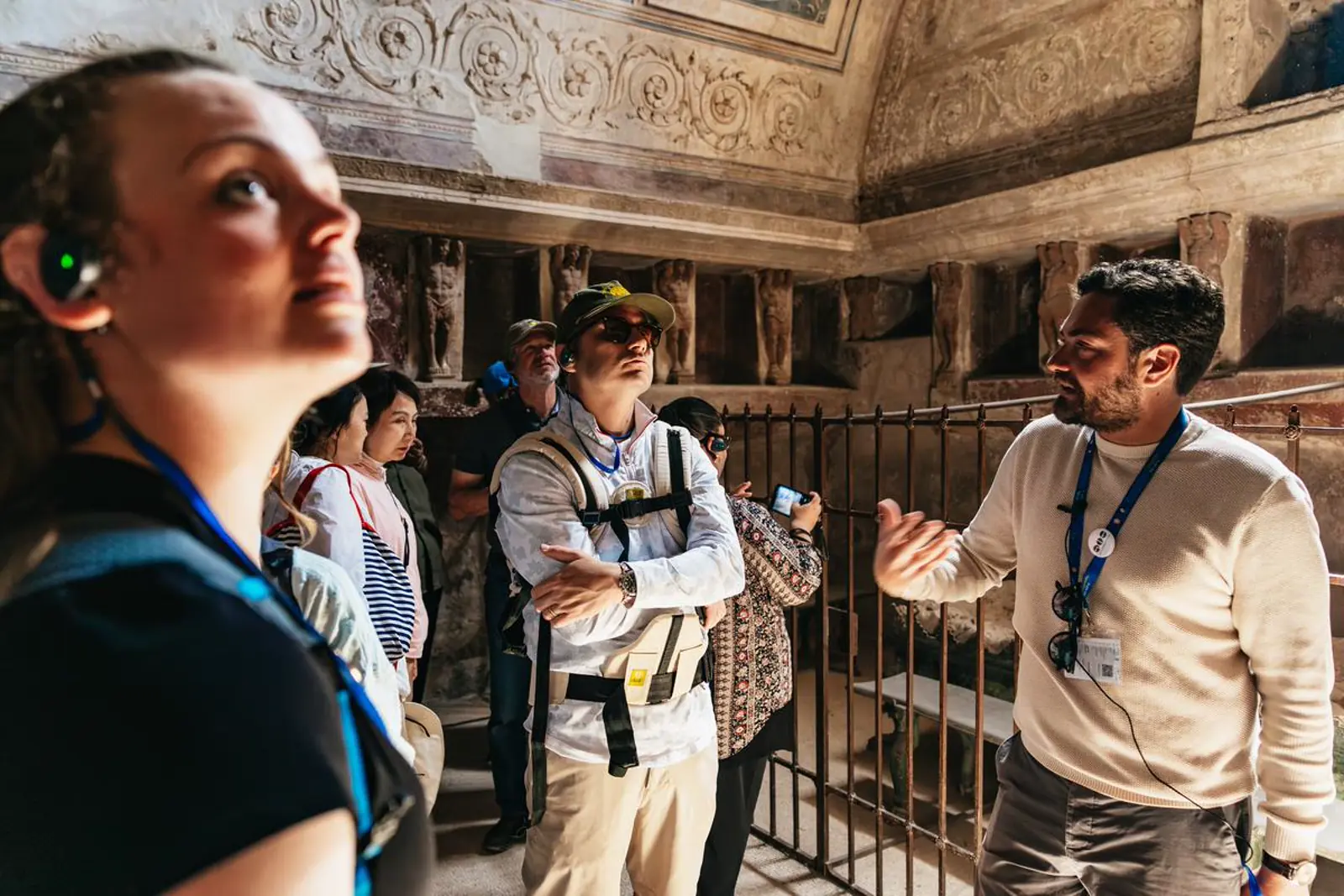
Two hours with an archaeologist in a group of up to 20, with your Pompeii Express ticket included and headsets for groups of ten or more. It covers the Forum and the main houses, the first half of the route above. Afterwards you can stay inside and walk the theatres, the baths or the amphitheatre alone. There is no transport, so you make your own way to the meeting point.
Check datesFree cancellation up to 24 hours before · secure checkout via GetYourGuide
Visiting Pompeii on Your Own in November, December, January or February
A self-guided walk can work especially well in the cooler months, when there is often more space and no risk of punishing heat. The trade-offs are shorter days, the chance of rain and the occasional temporary closure.
On the current official timetable, opening times from 15 October to 15 March are:
- Opening: 9:00 AM
- Last entry: 3:30 PM
- Closing: 5:00 PM
The park normally lists 25 December and 1 January as closed, unless it announces an exception. Check the official calendar for your year instead of relying on an old holiday article.
For a winter walk, start in the morning, see the indoor houses you care about before their earlier closing times, and keep the route flexible if heavy rain makes the ancient paving slippery. Waterproof shoes with good grip help more than an umbrella that takes up a hand on uneven steps.
Read our Pompeii in winter guide, the winter opening hours and what to do when it rains in Pompeii.
Practical Tips for Exploring Pompeii Independently
Buy a legitimate ticket before you arrive
For ordinary individual entry, follow the park's official website to its designated online ticket platform, Vivaticket. As of November 2026, tickets are personal and the park has a daily visitor limit. Buying ahead saves time at the ticket office, although you still go through the entrance checks.
GetYourGuide also sells entry bundled with extras, though none is rated as highly as the guided tours. The skip-the-line ticket with an audio guide is from $23 and rated 4.1 from more than 2,400 reviews; the ticket with a smartphone audio guide is from $24 and rated 4.2 from more than 1,500; and the ticket with a printed guidebook and itineraries is from $40 and rated 4.2 from 119 reviews. Read the recent reviews before you buy, and remember the park's rule on audio devices above.
Choose your entrance and exit as a pair
Porta Marina is the convenient gate for the Circumvesuviana's Pompei Scavi–Villa dei Misteri stop. Piazza Esedra is also on the western side. Piazza Anfiteatro is farther east and better for the amphitheatre or the park's designated accessible route. Trenitalia's Pompei station and the Circumvesuviana stations are different stations, so don't treat them as interchangeable.
You can't leave and come back on the same ticket
The park specifies single entry with no re-entry for ordinary Express and Pompeii+ tickets, so plan food, toilet stops and transport around that. There are refreshment points inside the site, but individual facilities can close for works.
Pack light
The park doesn't allow luggage or bags larger than 30 × 30 × 15 cm into the excavations, and lists paid luggage storage at Porta Marina and Piazza Anfiteatro. Bring a small bag, water, sun protection when it's needed and shoes with reliable grip.
Check accessibility before you use this route
This route crosses historic paving stones and steps, so it is not an accessible route. Visitors with limited mobility, wheelchair users and anyone with a pushchair should look at the official Pompeii for All route, which starts at Piazza Anfiteatro, instead of assuming the most direct walk is step-free.
Respect the ruins
Don't climb walls, touch frescoes or go into roped-off buildings. Follow the official directions and the current visitor rules: Pompeii is still being excavated and conserved.
Pompeii Without a Guide: Common Questions
Can you visit Pompeii without a guide?
Yes. An ordinary entry ticket lets you explore the main archaeological city on your own. Bring the park's map and choose your stops in advance, so you don't lose time walking between distant districts.
How long does it take to walk around Pompeii?
A focused highlights visit takes about 2 hours and the route on this page around 3 to 4 hours. A longer visit with the amphitheatre or the suburban villas can easily take 5 to 7 hours. You can't realistically see every excavated area in one short visit.
What is the best walking route around Pompeii?
For a first visit, start at Porta Marina and take in the Forum, the House of the Faun, the House of the Vettii, the Lupanar, the Stabian Baths and the Large Theatre, then finish near Piazza Esedra. Adapt it to that day's list of open buildings.
Is Pompeii easy to navigate on your own?
It is manageable with the official map, but the site is large and some ancient streets look alike. Allow time for detours, closures and uneven paving, and keep the map available offline.
Can you see the plaster casts of Pompeii's victims?
Yes. Casts are displayed in designated areas of the park, and the Large Palaestra is currently listed for an exhibition of casts and organic finds. Displays and access change, so check the park's open-buildings page before you set off.
Is the amphitheatre included in a Pompeii Express ticket?
Yes. The amphitheatre is part of the main ancient city. It is a long way from the Forum, though, so you need extra walking time or a route that enters or leaves through Piazza Anfiteatro.
Do I need Pompeii+ for the House of the Vettii?
No. The House of the Vettii is inside the main archaeological city, so the standard Pompeii Express ticket covers it when the house is open. Pompeii+ is for the suburban villas, such as the Villa of the Mysteries.
Can I go out for lunch and re-enter Pompeii?
No. Ordinary admission doesn't allow you to leave and come back on the same ticket. Have lunch before you go in, or use the refreshment points inside the archaeological area.
Is a self-guided visit suitable for children?
It can be, especially if you shorten the route, stop for breaks and focus on a few memorable buildings. Keep in mind the uneven stones, the distances and the explicit images in the Lupanar. For families who want a slower pace adapted to them, a private family tour with an archaeologist is the alternative.
Can You Do Pompeii Yourself? Yes, with a Map and a Plan
Absolutely. Pompeii is one of the most rewarding archaeological sites in Italy to explore on your own, as long as you arrive with the map and realistic expectations. Don't try to see everything. Pick a route that mixes the Forum's grand public spaces, the painted private houses and the streets, baths and theatres that show how everyday Roman life worked.
For most first-time independent visitors, three to four hours and a Pompeii Express ticket are a good start. Add a guide if you would rather spend the time listening to an expert than reading a map; the two-hour tour with an archaeologist still leaves you the afternoon alone. Choose Pompeii+ if the Villa of the Mysteries is a priority.
Next steps: compare guided tour options · check ticket types and prices · plan a winter visit · choose where to stay for Pompeii
Official Sources and Further Reading
Checked on 4 November 2026. Prices, access rules, opening hours and which houses are open can change, so check the official park website before you go.
- Official site map and guide (Pompeii Archaeological Park)
- Tickets and opening times (Pompeii Archaeological Park)
- Buildings currently open (Pompeii Archaeological Park)
- Visitor services and audio guides (Pompeii Archaeological Park)
- How to get there (Pompeii Archaeological Park)