Porta Marina
Nearest the Circumvesuviana station and the classic first stop. It's a short uphill walk from the ticket gate — the entrance most guided tours use.
Almost every bad Pompeii day traces back to a small logistical mistake made hours earlier — the wrong platform, the wrong gate, a house that turns out to be shut. Here are the five answers that prevent most of it, then the full detail below.
This single mix-up costs people forty minutes in the sun before they've seen a single fresco.
| Station | Line | Nearest entrance |
|---|---|---|
| Pompei Scavi–Villa dei Misteri | EAV Circumvesuviana, Naples–Sorrento | Porta Marina & Piazza Esedra (2-min walk) |
| Pompei (Trenitalia) | Mainline Naples–Salerno, in the modern town | Piazza Anfiteatro (10–15 min walk) |
| Pompei Santuario | EAV Circumvesuviana, Naples–Poggiomarino | Piazza Anfiteatro |
They sit on opposite sides of the ancient city, and walking the perimeter between them is a long, shadeless slog past car parks. From Naples, take the Circumvesuviana towards Sorrento and get off at Pompei Scavi–Villa dei Misteri — trains leave from Napoli Porta Nolana and Napoli Garibaldi (downstairs from Napoli Centrale, follow signs for Circumvesuviana or EAV, not the Trenitalia platforms). Budget about 35 minutes and roughly €3.30 one way; from Sorrento it's about 30 minutes the other direction. Don't type just "Pompeii" into your maps app — use the full entrance name.
The Circumvesuviana strikes more than you'd like. Industrial action is frequent enough to have ruined pre-booked timed-entry slots. Check eavsrl.it for strike notices two or three days out — on strike days there are usually guaranteed service windows, but they're unreliable for a timed slot. If one's announced, switch to the Trenitalia mainline and the Pompei Link shuttle bus, since the two networks strike independently.
Two more comfortable options: the Campania Express tourist train is air-conditioned with reserved seats and fewer stops, stopping at Pompei Scavi — worth it in August or with luggage and children. Or take a regional train to the mainline Pompei station and use the Pompei Link shuttle (about 15 minutes, small supplement) — this is also your fallback route when the Circumvesuviana is on strike.
The park has three official public entrances, and picking the wrong one is a predictable failure mode: someone books a tour meeting at Porta Marina, arrives at Piazza Anfiteatro, and spends half an hour walking the perimeter while their group starts without them.
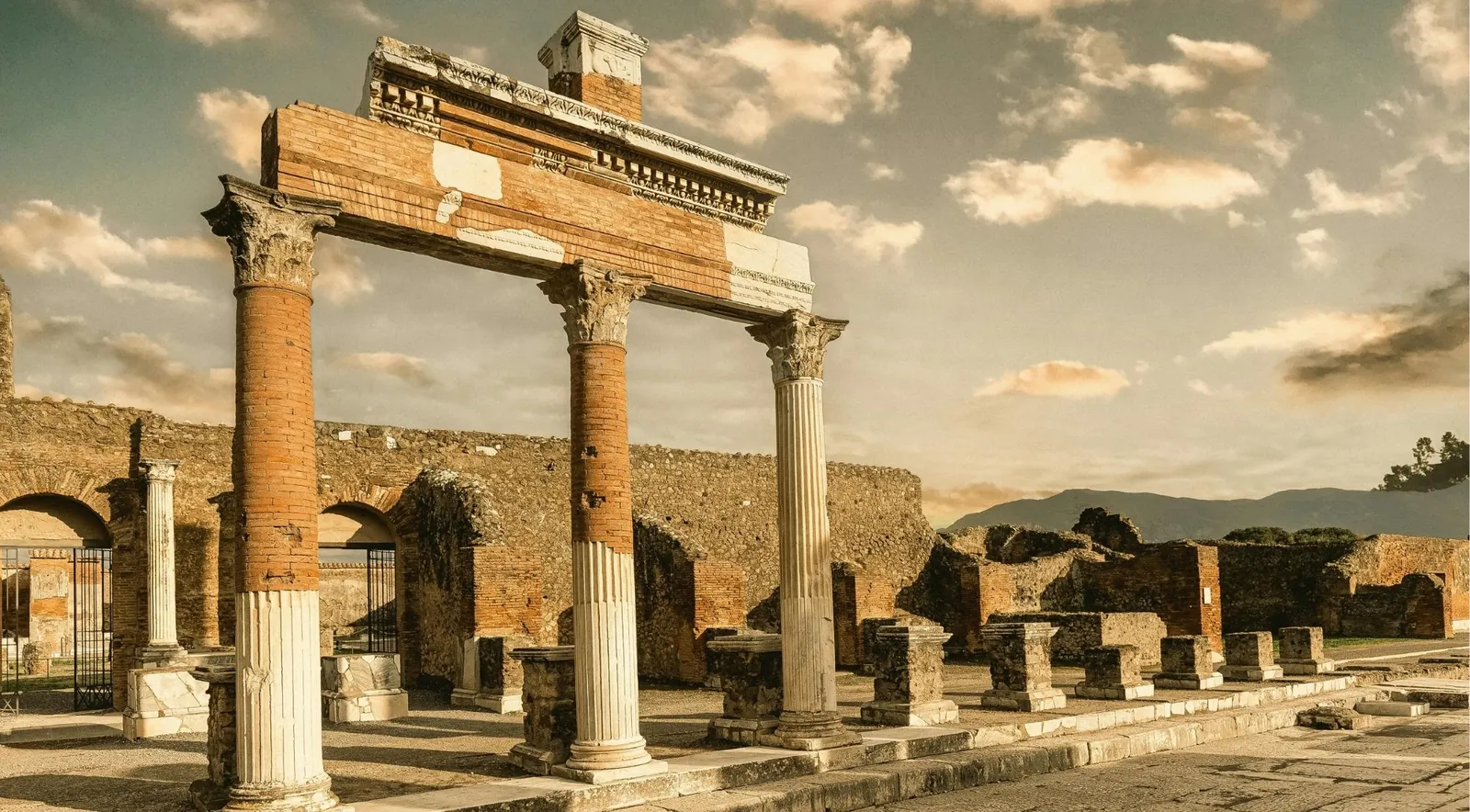
Nearest the Circumvesuviana station and the classic first stop. It's a short uphill walk from the ticket gate — the entrance most guided tours use.
Also by the station, and the way in for the Antiquarium (the site museum, included in your ticket). A lift here connects to the accessible route.
Nearest the amphitheatre, and the official start of the step-free "Pompeii for All" route. Reached from the Trenitalia mainline station.
What to do: read the exact entrance and meeting point on your booking before you leave the hotel, and search the full entrance name in your maps app. Doing the whole site end-to-end works nicely if you enter at Piazza Anfiteatro and exit at Porta Marina — you finish at the Forum with the Vesuvius view, standing right at the station.
Tickets changed in 2026, and half the internet hasn't noticed. The official seller is now Vivaticket, which replaced TicketOne in March 2026 — treat any blog still pointing you at TicketOne as a warning label. Tickets are also nominative (name printed, checked against photo ID), and the park caps admissions at 20,000 visitors a day with timed entry from mid-March to mid-October. For full 2026 prices, what each ticket covers and the free-Sunday scheme, see our guide to Pompeii tickets explained.
The park's own suggested itineraries run from about two hours to seven. Two hours gets you a highlights reel, not Pompeii.
| You have | Realistic plan |
|---|---|
| 2 hours | Forum, House of the Faun, Lupanar, Stabian Baths. Enter and exit at Porta Marina. |
| 3–4 hours | The above plus the Thermopolium, House of the Vettii, Via dell'Abbondanza, and the amphitheatre. Cross the city one way. |
| 5–6 hours | Add the Large Palaestra, Garden of the Fugitives, quieter Regio I and II streets, and the Villa of the Mysteries. |
| Full day | The above at a human pace, with a long lunch and the Antiquarium museum. |
What to do: pick three or four things you actually care about and build the route outward from them. Trying to walk every street is how people end up on a kerb at 2:00pm with a headache. The park also sells short thematic itineraries — "Civic Pompeii," "Daily Pompeii" — around 90 minutes, for a small supplement on top of entry.
Individual houses open and close for conservation work, staffing and restoration, sometimes at short notice — plenty of travellers plan a day around one house and find it shuttered. Check the "Open buildings" page on pompeiisites.org or the free MyPompeii app on the morning of your visit, then build your route from what's actually open. Worth prioritising when they are:
The civic heart of the city, with Mount Vesuvius framed at the end of the colonnade.
Site of the Alexander Mosaic (the original is now in Naples) and the "HAVE" welcome mosaic.
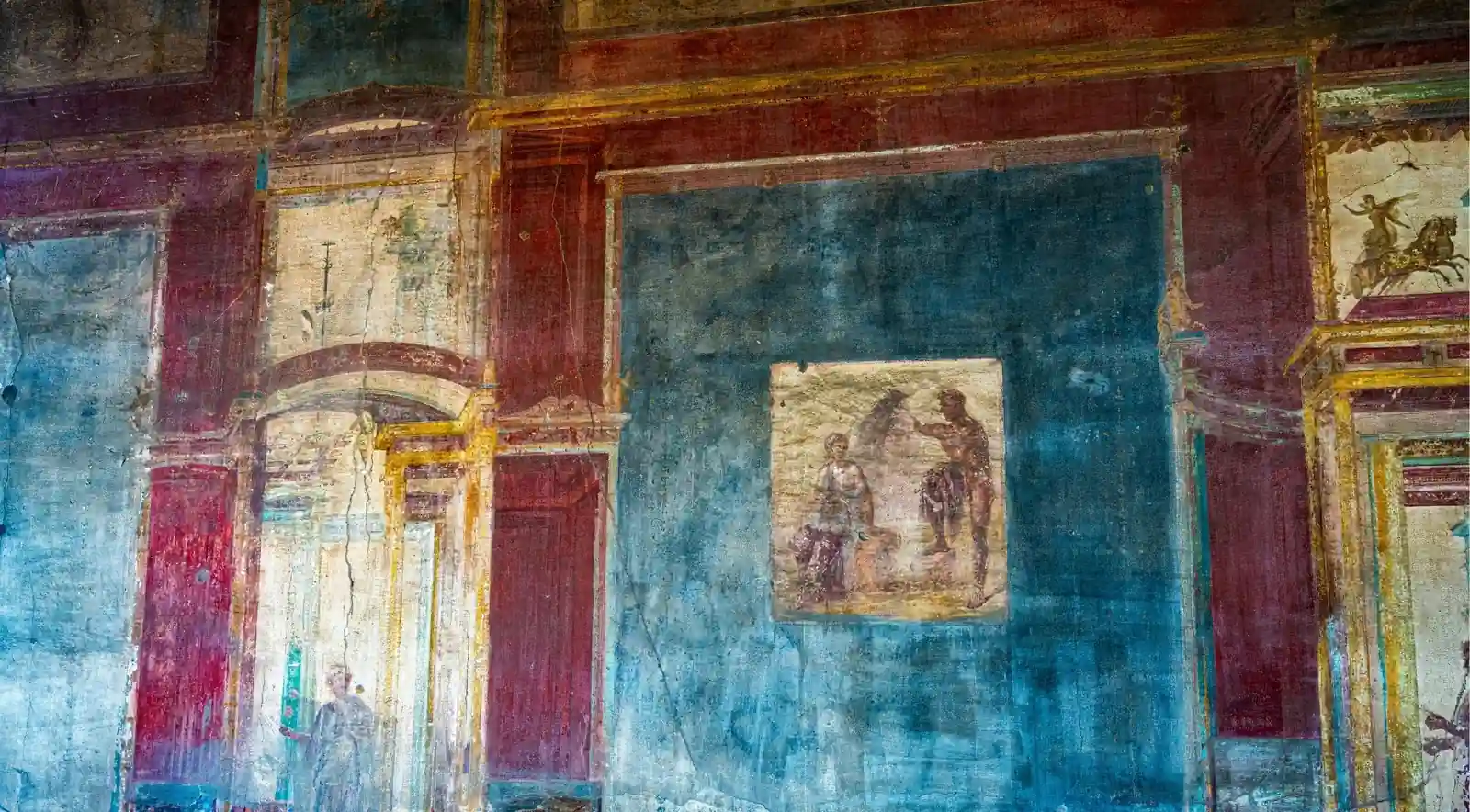
The best-preserved decorative interiors on site, after roughly twenty years of restoration. Read our full guide to the House of the Vettii →
An elevated, fully accessible walkway with a lift, where you can watch live excavation and restoration work. Open daily 10:30–18:00, capacity-limited.
A marble counter with holes in it once held hot food for sale — one of Pompeii's most-photographed small sites.
The oldest surviving Roman stone amphitheatre anywhere, blessedly quiet since it's a long walk from Porta Marina. The tiny Lupanar is permanently queued — go early or accept the shuffle.
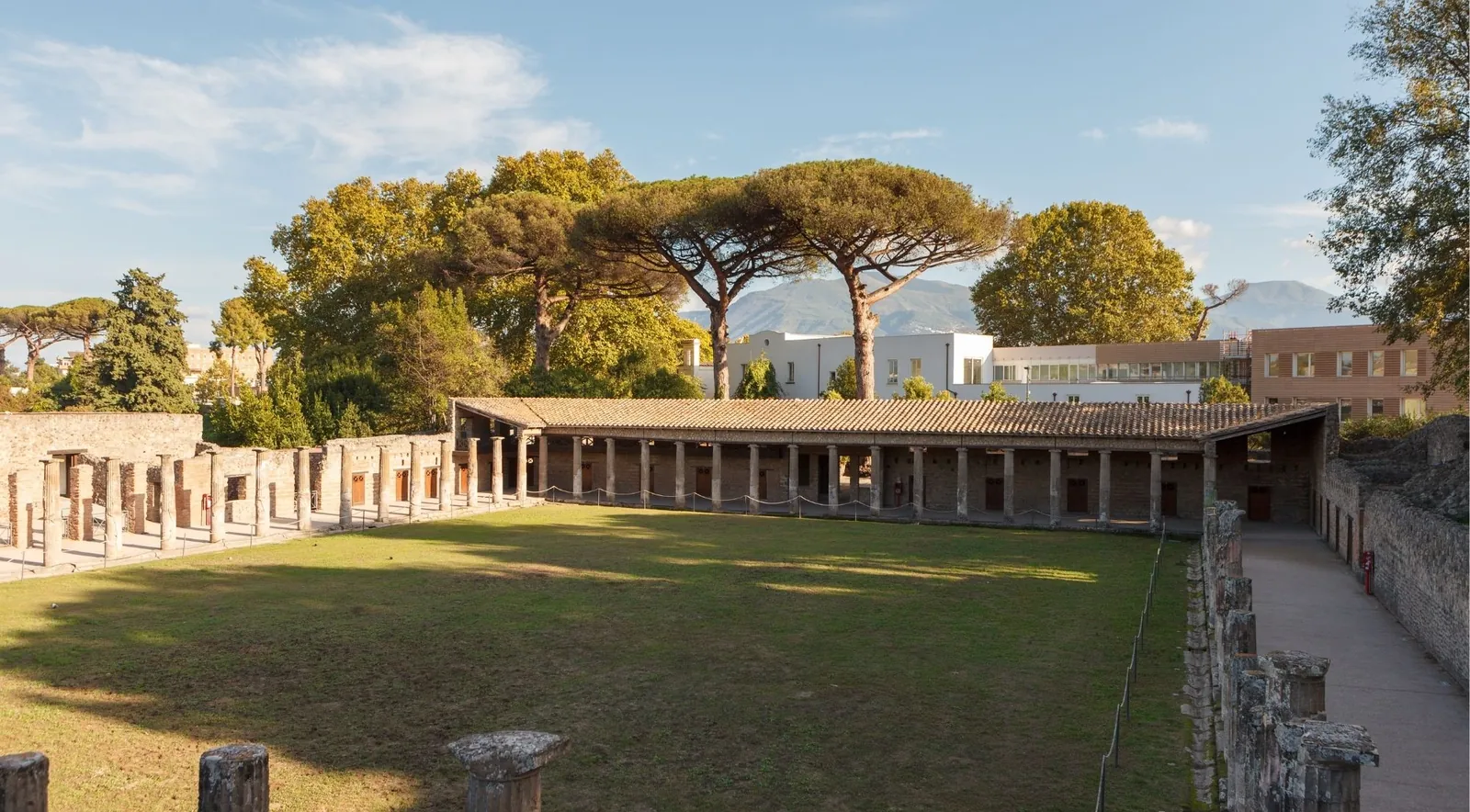
Where the plaster casts actually are: a permanent exhibition of more than twenty casts sits in the Large Palaestra (Palestra Grande), and — more affecting — thirteen casts remain in place in the Garden of the Fugitives, in Regio I near Porta Nocera. The second is worth the walk.
The newest thing to see: excavation in Regio IX has run since 2023, and in February 2025 the park unveiled a near life-size Dionysian frieze in the House of the Thiasus. Staff-led visits to the dig run Monday to Friday at 11:00 for two small groups, included with a standard ticket and booked by phone.
Without one, a lot of Pompeii looks like broken walls. A marble counter with holes in it is a fast-food bar. Faded red lettering is an election poster. A house's floor plan tells you the owner's wealth, his politics and whether he was in trade — none of it is signposted. What works well: a two-hour guided visit first thing, then two or three hours exploring on your own with the context in your head. That beats five unguided hours almost every time, and it beats a five-hour guided march for most people's attention spans.
Official audio guides are sold at all three entrances if a live guide isn't for you — just note the park's regulations don't allow bringing your own audio-guide device. And Italian guides must hold a regional licence: licensed guides do not tout outside the gates. Anyone approaching you at the station or the entrance is selling something else. For the full rundown of tour formats, prices and the best-rated options, see our guide to Pompeii guided tours.
Signage near the station promising free maps and staff in matching t-shirts are usually selling overpriced maps and outdated audio guides.
Hawkers at the mainline station push bus tours that under-deliver on time and content. Real guides don't need to solicit on the street.
Flat fares quoted outside the station often bear no relation to the meter. Ask for the meter or confirm the fare in writing first.
Generic "buy Pompeii tickets" sites charge large markups on standard entry, often bundling in extras you don't need.
When booking any tour, confirm four things: the exact meeting point and entrance, whether the entry ticket is included, the duration, and the actual maximum group size. "Small group" means nothing without a number attached.
Four things people consistently underestimate because they picture a museum, not a large outdoor archaeological site.
Long exposed streets, very little shade, and stone that stores and throws back heat. The park's own advisory: light, loose, light-coloured fibres; a hat; high-SPF sunscreen; and drink water before you feel thirsty. In June–September, book the 9:00 slot and treat 1:00pm as your outside limit for serious walking. Refill at the drinking fountains marked on the site map rather than buying bottled water, and rest in shaded spots like the Triangular Forum, the amphitheatre ambulacra or the House of Menander.
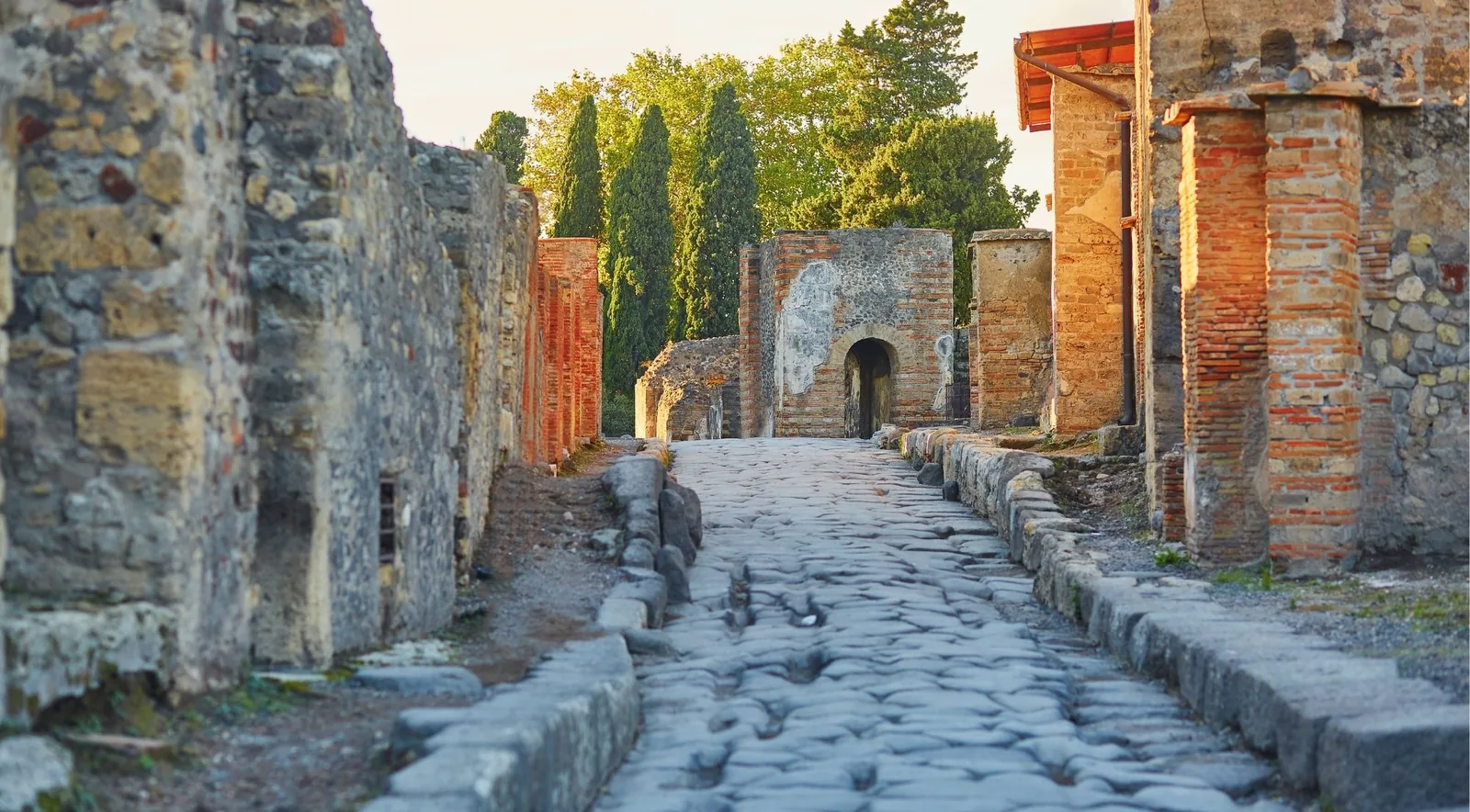
Large irregular basalt blocks, deep cart ruts, gaps and high kerbs, plus stepping stones built for Roman feet rather than modern ones. Even confident walkers tire, because the surface demands constant attention. Flip-flops, sandals and new shoes are all mistakes here — wear supportive trainers or walking shoes you've already broken in.
Bags larger than 30 × 30 × 15 cm aren't permitted inside. Each entrance has a free cloakroom (Porta Marina Superiore has an automated deposit with a claim code). For anything bigger, use the left-luggage office at the Pompei Scavi Circumvesuviana station, or leave suitcases at your station of origin — don't arrive at the gate with a wheeled carry-on.
Toilets sit at each entrance plus near the Forum café and the small theatre; the main café is near the Forum with a second at Porta Marina. Both are jammed 12:00–14:00 — eat at 11:30 or 2:15pm and you'll walk straight up. Free water fountains are dotted through the streets; a refillable bottle is the single best piece of kit for a Pompeii day. Picnicking is allowed only in designated areas.
It sits outside the main walled city — through the Herculaneum Gate and along the Street of the Tombs, near the Villa dei Misteri station — and the basic ticket doesn't include it. You need the upgraded ticket covering the suburban villas, bought up front or added at the Herculaneum Gate (card only). If it's a priority, buy the upgrade from the start and visit it last, exiting near the station. See Pompeii tickets explained for exact 2026 prices.
The "Pompeii for All" step-free route runs over 3.5 km from Piazza Anfiteatro to the Antiquarium lift at Piazza Esedra, with non-slip surfaces and ramps. The park is honest about its limits too: some ramps exceed an 8% gradient, ancient paving stays uneven, and only parts of the route fit two wheelchairs side by side. Foldable wheelchairs can be borrowed at Piazza Esedra and Piazza Anfiteatro — reserve ahead with the park.
Coverage around the entrances can be patchy, which matters when your ticket lives in an email. Screenshot your QR codes before you arrive, and download the free MyPompeii app and the official site map PDF while you still have wifi. You'll also be handed a free paper map at entry — take it, since the site is deliberately light on signage and paper reads easier than a phone screen in the glare.
Dogs up to 10 kg on a lead (and carried inside buildings); no drones without authorisation; no professional camera gear — tripods, video rigs — without a permit; no bare chests, beachwear or costumes; no flags or banners; no smoking outside designated areas or climbing on walls; and no re-entry once you leave on the same ticket.
Herculaneum might suit you better. If you have limited time, mobility concerns, small children, or a low tolerance for heat and crowds, Herculaneum is often the better visit — it's on the same Circumvesuviana line (get off at Ercolano Scavi), a fraction of the size, far better preserved (wooden beams, upper storeys and carbonised furniture survive there), and sees roughly an eighth of Pompeii's visitor numbers. Two to three hours covers it comfortably, with considerably more shade. Pompeii still wins on scale and on the feeling of walking a complete ancient city — but it's worth knowing the alternative exists before you commit a hot August afternoon to the wrong one.
Plan the rest of your visit:
Answer-first — the questions people actually ask before visiting.
Use Pompei Scavi–Villa dei Misteri on the Circumvesuviana line between Naples and Sorrento. It's a two-minute walk from the Porta Marina and Piazza Esedra entrances. The separate Trenitalia station called simply "Pompei" sits in the modern town and is closest to the Piazza Anfiteatro entrance instead — don't type just "Pompeii" into your maps app, use the full station name.
Three to four hours covers the main sights at a reasonable pace. Five to six hours lets you add the amphitheatre, the quieter residential quarters and the Villa of the Mysteries. Two hours gets you a highlights loop around the Forum, the House of the Faun, the Lupanar and the Stabian Baths, but you'll miss most of the city.
In July, August, on public holidays and on weekends from April to October, yes — the park caps admissions at 20,000 a day and issues timed entry slots, and the morning window fills first. Off-season and midweek you can usually walk up. Tickets are nominative, so bring photo ID matching the name on the booking. See our full guide to Pompeii tickets, prices and skip-the-line for the complete 2026 breakdown.
9:00, right when the gates open. You get cooler air, softer light over the Forum, and roughly ninety minutes before the tour groups and cruise-ship excursions arrive in force. Mid-to-late afternoon is the second-best window, once the day-trip surge has moved on.
Individual buildings at Pompeii open and close on rotation for conservation, restoration and staffing reasons, often at short notice. Check the "Open buildings" page on the official park site, or the free MyPompeii app, on the morning of your visit and build your route around what's actually open that day. The House of the Vettii is a common casualty of this — see our full guide to the House of the Vettii for what's inside if it's on your list.
Only if it's smaller than 30 × 30 × 15 cm. Larger bags must go in the free cloakroom at the entrance. Suitcases should be left at the Pompei Scavi station's left-luggage office, or at your departure station in Naples or Sorrento — don't arrive at the gate with a wheeled carry-on expecting it to be waved through.
Partly. The "Pompeii for All" route covers over 3.5 km of step-free paths starting at Piazza Anfiteatro and exiting via the Antiquarium lift at Piazza Esedra. Some ramps exceed an 8% gradient and the surrounding ancient paving is uneven. Foldable wheelchairs can be reserved in advance at Piazza Esedra and Piazza Anfiteatro; strollers struggle badly off the accessible route, so a baby carrier works better.
Not strictly, but a first visit is far richer with one — most of the site reads as bare walls without context. A common approach is a two-hour guided introduction followed by independent exploration on the same ticket. Official audio guides are sold at all three entrances, but you can't bring your own audio-guide device. See our guide to Pompeii guided tours for formats, prices and the best-rated options.
Pompeii for scale and the experience of walking a complete ancient city. Herculaneum for preservation — wooden beams, upper storeys and carbonised objects survive there — and for a shorter, shadier, far less crowded visit on the same Circumvesuviana line (get off at Ercolano Scavi). Herculaneum is the better call with young children, mobility concerns, or in high summer heat.
Once the logistics are sorted, most visitors build a wider Bay of Naples itinerary around them — a Mount Vesuvius crater hike, a Herculaneum add-on, a day trip along the Amalfi Coast, a boat to Capri, an afternoon in Sorrento, or a stop in Naples for the Archaeological Museum. Check live prices and times below.